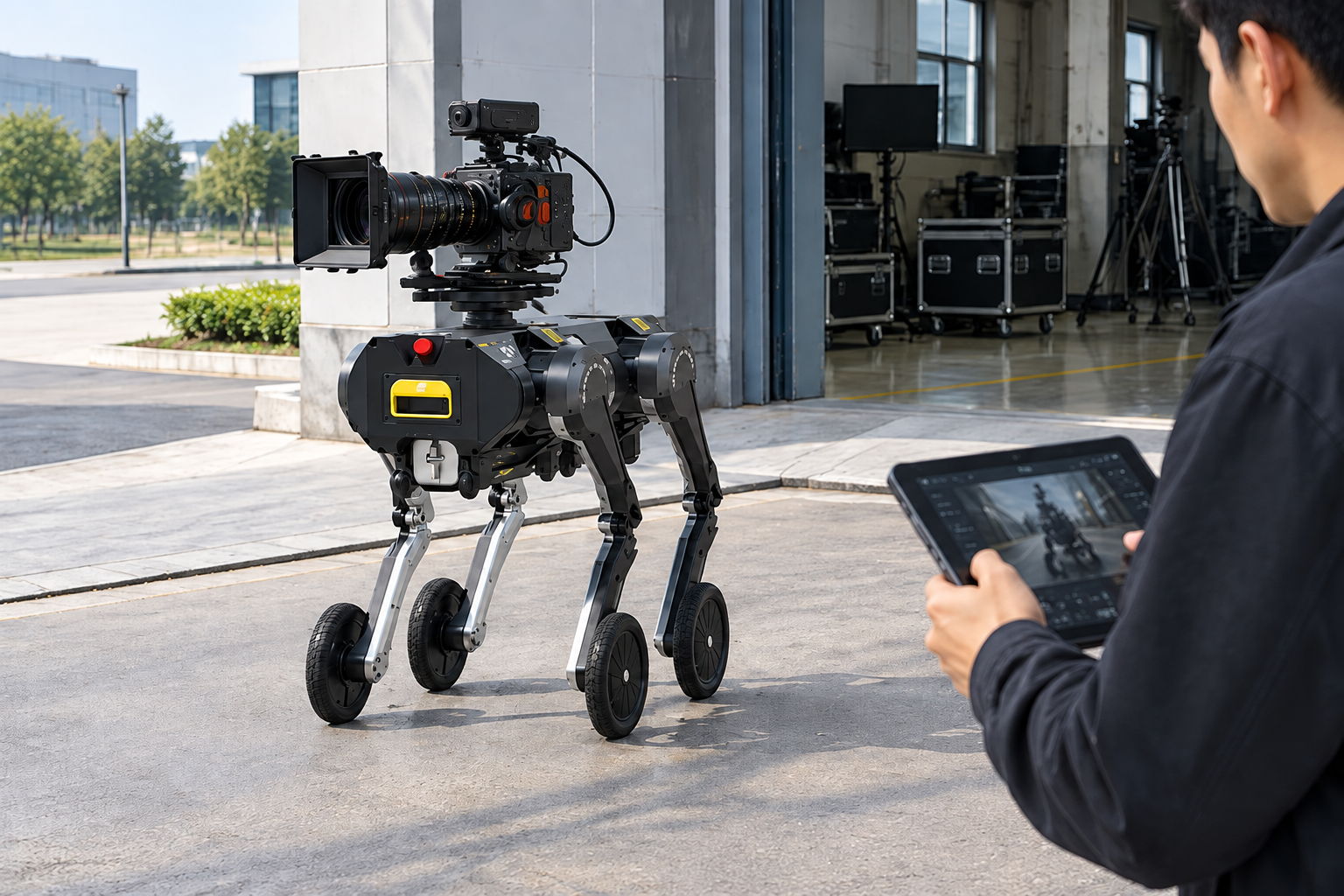
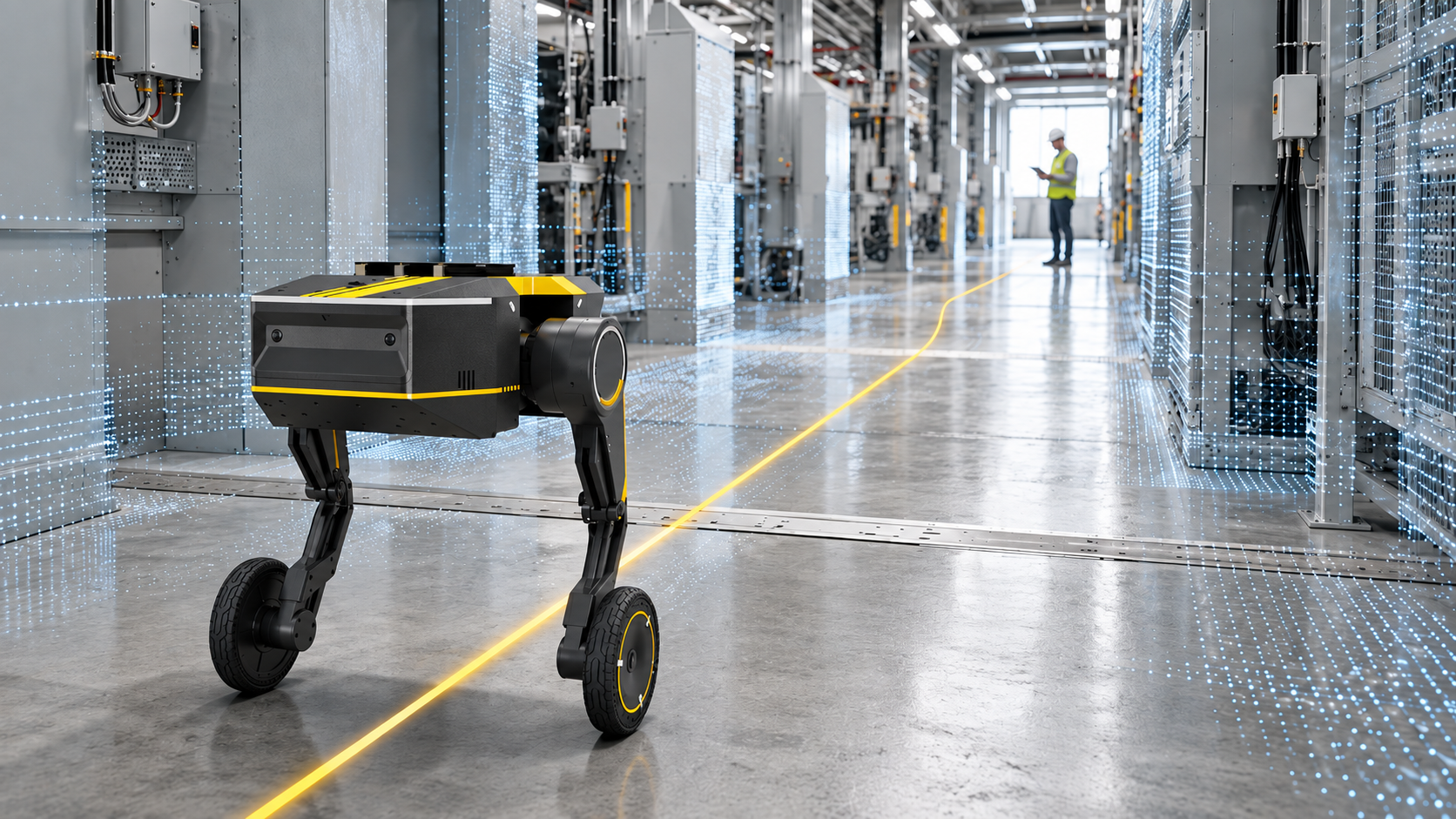
A robot that performs well in a lab can still struggle when the ground, payload, or mission changes. That gap is why we built D1, the multi-form robot platform we also call D-infinite. Field work rarely stays within one posture, one floor surface, or one operating mode, so we designed D1 to change its stance and locomotion form as the job changes. The same hardware can support a research experiment in the morning and an inspection route in the afternoon.
Why Multi-Form Robot Design Matters for Field Robotics
Embodied AI has advanced quickly in simulation and in controlled test areas. Deployment is less forgiving. Gravel, curbs, wet grass, stair landings, and cargo that changes weight during a shift all place demands on a machine built around a single posture. Many teams end up operating one robot for indoor mapping, a second for rough outdoor ground, and a third for heavier transport tasks. Budgets stretch, spare parts multiply, and every additional platform introduces another software stack to maintain.
Our engineers heard that requirement from labs and integrators often enough that we reconsidered the hardware from the ground up. The result is a bottom-up framework built around multi-collaboration and multi-locomotion, and D1 is where that framework becomes a working machine. Further background on the company and the design path is available in our company story.
A Multi-Form Robot Built for Real-World Mobility
D1 combines bipedal wheel-legged movement and quadruped movement in a single modular body. Standing on two wheel-legs keeps the footprint narrow and raises sensors to a more useful height, which matters in corridors, elevators, and warehouse aisles. Moving into the four-point configuration lowers the center of gravity and distributes load across more contact points, which suits broken ground and heavier transport. Depending on the selected locomotion form, D1 supports 2 m/s in bipedal mode and 3.2 m/s in quadruped mode.
Obstacle handling is where form switching becomes most visible. For obstacle evaluation, the documented maximum obstacle is 70 cm, while 50 cm is the recommended operating obstacle for safer testing. Both figures describe D1 under our own test conditions and should not be read as a general standard for wheel-legged robots.
Payload That Opens Up New Applications
Payload is one of the clearest ways to see why D1 is different. D1 supports 80 kg of standing payload, and more than 100 kg in the prone configuration, on a platform weighing 24.3 kg without docking and 48.5 kg with docking. That capacity moves the platform out of demonstration use and into working use, whether the load is a robotic arm, a sensor mast, a supply crate, or equipment carried during a rescue exercise. Teams comparing D1 against our other platforms can review the side-by-side figures across our full robot lineup.
Field Time Long Enough to Complete the Route
Endurance ends more field trials than terrain does. In no-load wheel-legged testing, D1 delivers at least 5 hours of runtime and up to 25 km of range, with charging completed in less than two hours. Real payload and rough ground will reduce those figures, as they will on any mobile robot, but the headroom means a survey loop or an inspection round rarely has to be cut short. D1 is designed for teams that need repeated testing cycles within the same workday.
Where D1 Goes to Work
Flexible form switching matters because it turns one platform into several deployments. The applications we see most often include the following.
- Embodied AI and robotics R&D labs, where a general-purpose platform supports papers, experiments, and student projects
- Security patrol and inspection routes through industrial parks, campuses, and residential areas
- Short-distance delivery and logistics trials inside warehouses and closed sites
- Emergency rescue and field robotics testing on ground that wheels alone cannot handle
- Mobile filming, live demonstration, and multi-locomotion research
Development-Ready on Arrival
Capable hardware is held back by a difficult software environment, so D1 ships on NVIDIA Jetson Orin NX 8GB running Ubuntu 22.04 with ROS 2 support. Navigation, perception, and secondary development workflows start in a familiar environment. Connectivity covers two USB-C ports, one Ethernet port, and a charging port, while modular expansion covers a robotic arm, depth camera, LiDAR, larger wheels, and OTA updates. Unboxing videos, the user manual, and the Ubuntu development documentation are collected on the D1 tutorials page.
Bringing a Multi-Form Robot Into the Next Project
Fixed-form robots will continue to have their place. For teams whose work does not stay in one environment, a platform that reshapes itself around the mission is a closer fit. D1 is offered through two regional purchase paths, one for Europe and one for all other regions, in single and double unit configurations depending on whether a project requires parallel testing.
Because pricing, shipping, and regional availability may change over time, final purchase details should follow the current information shown on the official product page and order confirmation. Full configuration details and ordering information are available on the D1 multi-form robot product page.