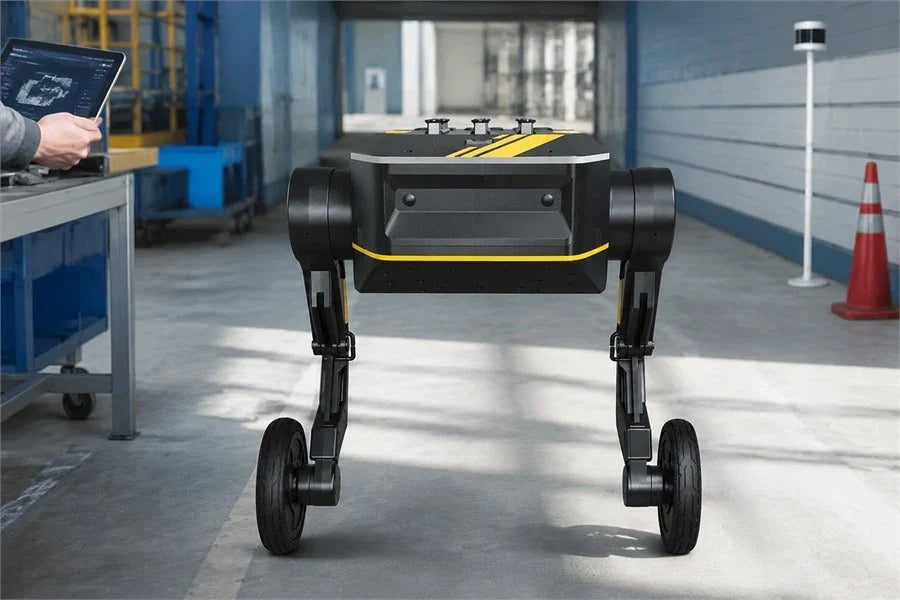
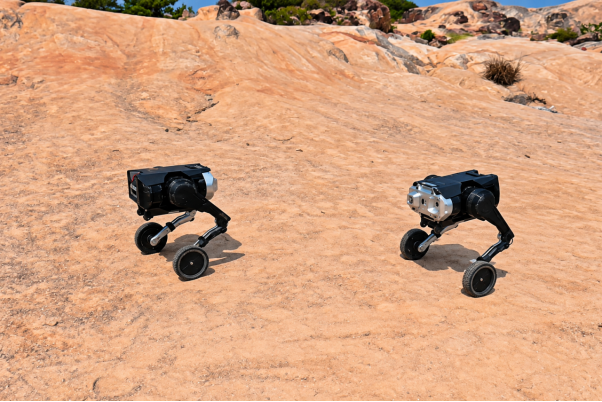
At Direct Drive Tech, we designed DIABLO around a practical mobility challenge: changing a mobile robot's body height and wheel-to-body geometry without giving up self-balancing wheeled travel. DIABLO combines a wheeled base, six direct-drive joints, articulated legs, and selectable body configurations. In standing mode, it can travel at up to 2 m/s and carry up to 4 kg. In creeping mode, the maximum load increases to 80 kg as the robot adopts a lower body configuration. These figures apply to different operating configurations, rather than defining one universal performance envelope.
For engineers evaluating a four-bar linkage leg robot, the key considerations are body height, wheel placement, load support, and controllable posture. DIABLO brings this mechanical approach to a self-balancing wheeled-leg platform rather than a robot arm. Its linkage helps the robot transition between upright travel, a squatting posture, and a lower creeping configuration while the wheels continue to provide rolling mobility.
Why the four-bar linkage leg matters to DIABLO movement
DIABLO uses a compact wheeled-leg architecture in which the legs contribute to movement, posture control, and terrain interaction. The four-bar linkage guides the leg assembly along a controlled path, helping coordinate changes in body position and wheel placement. We view the linkage, wheel drive, direct-drive joints, and self-balancing control as an integrated mobility system.
What Is a Four-Bar Linkage Leg?
A four-bar linkage leg uses four connected members to guide movement between the robot frame and a moving leg or wheel assembly. The fixed link attaches to the frame, while the input link receives rotary motion from a driven joint. The coupler connects the input and output links, and the output link transfers the resulting movement to the leg assembly. Together, these members create a controlled and repeatable motion path.
As the driven joint rotates, the coupler and output link change the relative position of the wheel, leg, and body. This movement can combine vertical displacement with changes in wheel-to-body geometry, allowing a mobile robot to adopt different body configurations through one coordinated linkage system. In DIABLO, the four-bar leg works alongside six M1502D direct-drive joints to support the platform's wheeled-leg architecture.
How the Four-Bar Linkage Leg Robot Changes Body Height and Load Behavior
The four-bar linkage converts rotary joint motion into coordinated movement of the leg and wheel assembly. As the linkage moves toward a taller stance, DIABLO gains ground clearance and a higher working position. As it moves into a lower configuration, the robot occupies less vertical space and the relationship between the body and wheels changes. This controlled geometry allows the platform to adapt its posture for different mobility requirements.
The same configuration affects how the robot handles a payload. Loads are transferred through the body and frame, the articulated legs, and the wheel-ground contact points. A lower configuration can bring the payload closer to the support plane and create a more compact operating profile, making it useful to evaluate for payload-handling tasks. Our recommendation is to consider the payload's center of mass, mounting position, ground friction, and route conditions before relying on the balance controller.
One leg architecture, two operating modes and one squatting posture
| DIABLO operating mode | Movement role | Verified operating boundary |
|---|---|---|
| Standing mode | Upright wheeled movement, body positioning, and sensor-carrying work | Maximum travel speed of 2 m/s and maximum load of 4 kg |
| Creeping mode | Lower-profile, slower travel with a substantially higher payload allowance | Maximum load of 80 kg |
Standing mode: preserving agile wheeled travel
Standing mode is DIABLO's upright operating configuration. The wheels provide travel while the articulated legs remain available for balance and body adjustment. The four-bar linkage makes the posture a controlled mechanical state rather than a permanently fixed chassis height. The 2 m/s maximum travel speed and 4 kg standing-mode maximum load remain configuration boundaries, so route planning must account for floor condition, payload height, center of mass, cable routing, visibility, and stopping space.
Creeping mode: selecting a lower profile for load-oriented movement

Creeping mode connects the linkage to a different mobility priority. Its maximum load is 80 kg, substantially higher than the standing-mode maximum load. This lower configuration deserves attention when a project values load support and compact body position more than maximum speed. Confirm mode engagement, payload distribution, floor condition, battery state, clearance, and duty cycle before movement.
Squatting posture: a controlled intermediate body relationship
Squatting is best understood as a posture or configuration rather than a separate operating mode. By lowering the body while retaining the articulated leg structure, DIABLO can adjust its sensor viewpoint, reduce its vertical profile, and change the relationship between the wheels and body when approaching a load or navigating a confined space. This intermediate posture expands the robot's usable movement range while preserving its core wheeled-leg architecture.
Dimensions and clearance
DIABLO uses its linkage configuration to occupy two different height envelopes while maintaining the same footprint. In standing configuration, the robot measures approximately 540 x 371 x 491 mm. In creeping configuration, it measures approximately 540 x 371 x 270 mm. The footprint remains approximately 540 x 371 mm in both configurations, while the body height changes significantly.
This range gives integrators more flexibility when planning routes and installing payloads. When positioning DIABLO around doorways, ramps, equipment clearances, loading interfaces, sensor fields of view, or payload mounts, account for the height and body geometry of the selected configuration.
DIABLO specifications and operating conditions
| Specification | Published value or requirement |
|---|---|
| Standing-mode maximum travel speed | 2 m/s |
| Standing-mode maximum load | 4 kg |
| Creeping-mode maximum load | 80 kg |
| Standing dimensions | Approximately 540 x 371 x 491 mm |
| Creeping dimensions | Approximately 540 x 371 x 270 mm |
| Drive system | Six M1502D direct-drive joints |
| Application conditions | Confirm surface, payload center of mass, temperature, battery state, and duty cycle for the selected configuration. |
Coupling four-bar leg motion with wheel-driven travel
DIABLO combines wheel-driven travel with articulated leg movement. The wheels support efficient rolling on suitable surfaces, while the legs adjust body height and posture. The four-bar linkage connects these two functions mechanically, allowing the wheel and body positions to change together as the robot moves from upright, agile travel toward lower, load-oriented movement.
Six M1502D direct-drive joints support DIABLO's articulated body. The DIABLO platform architecture brings the direct-drive joints and self-balancing control together within the wheeled-leg design. The DIABLO tutorial and SDK resources support operation and integration with external sensors, custom control interfaces, and application software.
This development path also makes DIABLO suitable for robotics research and application development. Teams can compare standing and creeping routes, observe sensors at different body heights, collect balance data, or build a supervised navigation layer while tracking the selected mode, body state, motor feedback, battery condition, payload position, and surface response.
What to evaluate before choosing a configuration
DIABLO is built to give one mobile platform multiple ways to work. Choose standing mode when speed, responsiveness, and agile inspection are the priority. Choose creeping mode when you need a lower profile and support for a maximum load of up to 80 kg. Use the squatting posture when body height, clearance, or sensor positioning matters most.
The value of DIABLO extends beyond its mechanical design. With the DIABLO SDK documentation and ROS 2 resources, development teams can move from basic keyboard control to custom dashboards, joystick interfaces, supervisory controllers, and higher-level autonomy experiments. Whether you are developing an inspection platform, payload-handling solution, or research prototype, DIABLO provides a flexible foundation for turning a mobility concept into a working robotic application. Contact Direct Drive Tech to discuss payload, terrain, operating mode, and application-specific configuration requirements.