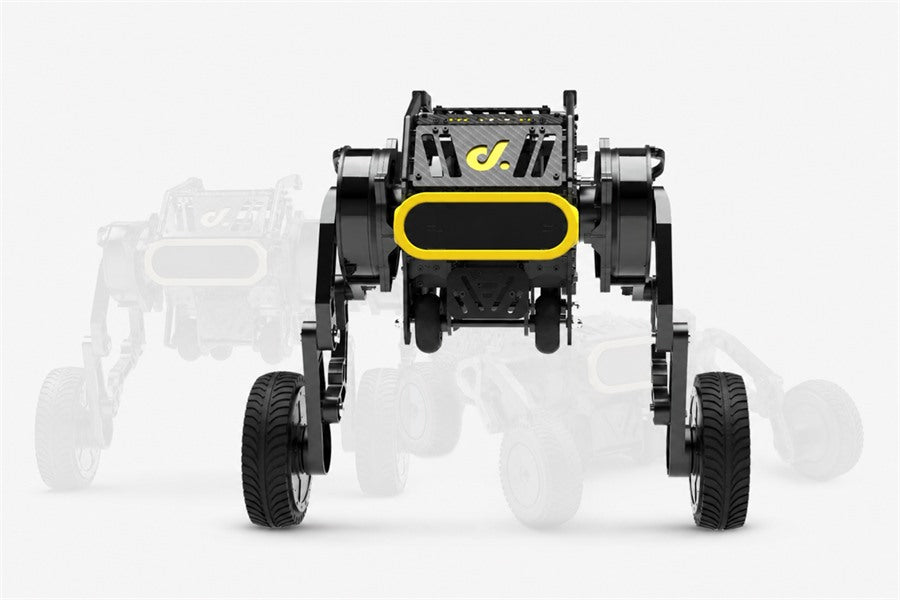
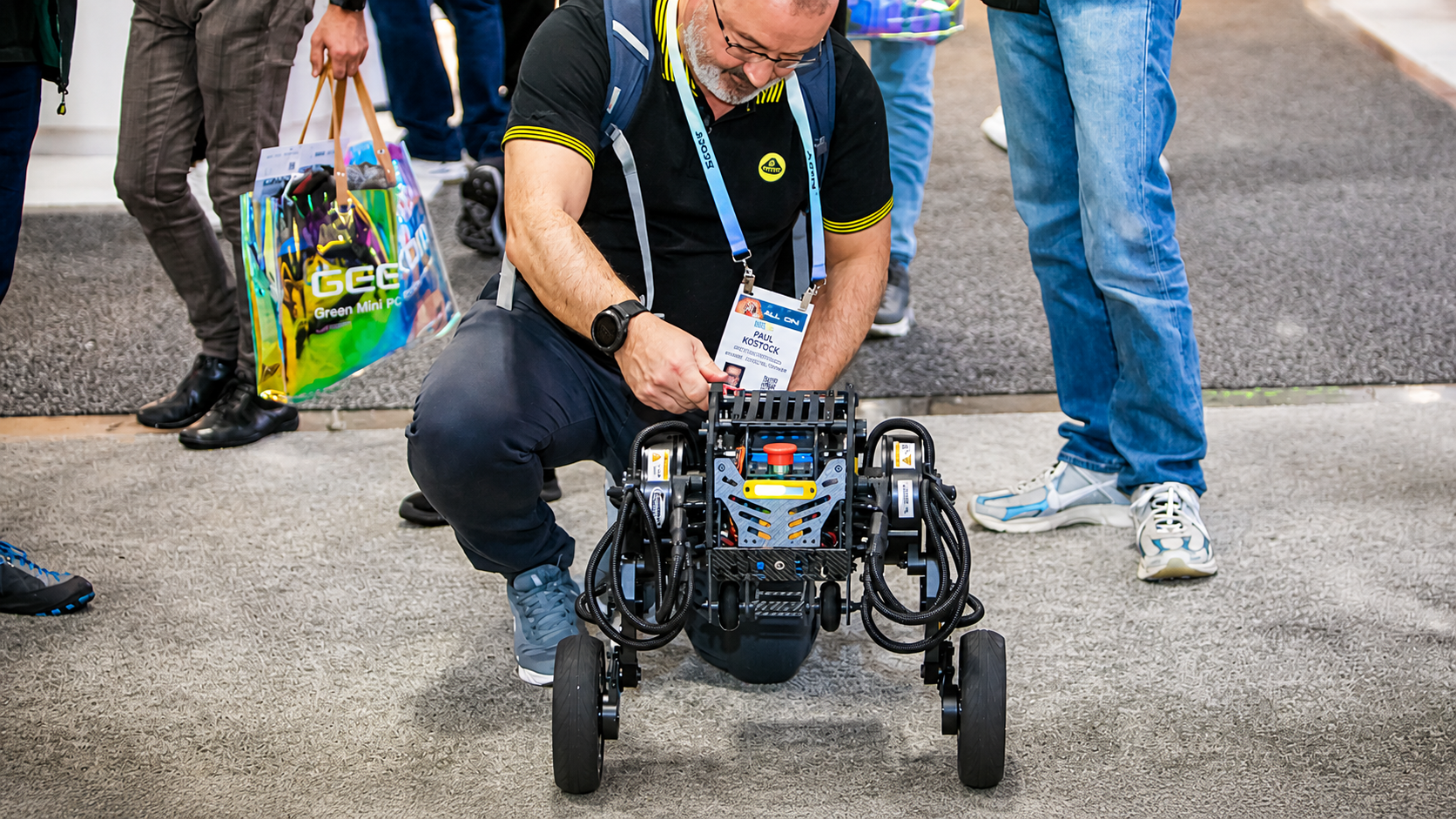
At Direct Drive Tech, we built Diablo as a self-balancing wheeled-leg robot platform for developers, research teams, and system integrators. Known globally as Diablo, it is designed to serve both as a mobile robot and as an open robot development platform for teams building real-world autonomous applications.
Unlike conventional AGVs that operate only on flat surfaces, our Diablo platform combines wheeled mobility with legged adaptability, allowing it to balance, jump, cross obstacles, and traverse terrain that would stop a standard wheeled chassis. With an open SDK and modular hardware architecture, we make it easier for developers to start from a proven mechanical platform instead of building the robot base from scratch.
In the latest version, we integrate the RaspberryPi4ModelB development board into Diablo, adding edge AI computing capabilities to a platform that was already strong in locomotion, mechanical openness, and secondary development.
Direct-Drive Wheeled-Leg Robot Design
At the core of Diablo's design is our direct-drive wheeled-leg structure. We power the robot with six M1502D direct-drive robot joint modules arranged in a dual-leg, dual-wheel configuration. Each joint connects the motor directly to the load without a reduction gearbox, helping reduce mechanical complexity, lower friction, and deliver more responsive torque output.
This architecture gives Diablo several motion capabilities that set it apart from conventional wheeled platforms. In standing mode, the robot maintains full self-balancing and dynamically adjusts its posture in real time. It can perform vertical jumps of up to 14 cm and lateral jumps of up to 8 cm, cross 5 cm obstacles smoothly during normal operation, and overcome 10 cm obstacles with single-leg stepping. We also use flange-based modular connections so individual joints or leg assemblies can be replaced more easily in the field, helping reduce maintenance downtime.
Diablo operates in two locomotion modes. Standing mode supports agile, upright movement at speeds up to 2 m/s with a 4 kg dynamic payload, making it suitable for sensor-carrying tasks such as mapping and patrol. Creeping mode lowers the center of gravity and supports payloads up to 80 kg, enabling heavy-load transport across warehouse floors and industrial corridors.
Why Diablo Works as a Robot Development Platform
Diablo is not a fixed-function robot. It is an open platform built for secondary development.
We provide a full SDK that gives developers direct access to Diablo's motion control interface, allowing custom gait programming, real-time balance adjustments, and trajectory planning. Teams can develop and deploy their own motion strategies rather than being limited to pre-set behaviors. The platform supports ROS integration, which means developers working within the standard robotics middleware ecosystem can bring their existing navigation, SLAM, and perception stacks onto Diablo without rebuilding from a proprietary framework.
On the hardware side, Diablo is designed with expansion in mind. The platform supports mounting additional sensors — LiDAR, depth cameras, GPS modules, and custom payloads — through standardized mechanical and electrical interfaces. This makes it a practical base for prototype development across a range of robotics applications, from autonomous navigation research to inspection system validation.
We provide developer resources through our GitHub organization, including SDK repositories, sample projects, onboarding tutorials, and development documentation covering Ubuntu-based workflows. The goal is to minimize the time developers spend on platform-level integration so they can focus on the application layer.
Mobility Advantages for Real-World Robotics
Most mobile robots choose between wheels and legs — wheels for speed and efficiency, legs for terrain adaptability. Diablo combines both in a single platform.
In practical deployment, this means the robot can travel at wheeled-robot speeds on smooth surfaces, then transition to obstacle-crossing and stair-edge navigation when the terrain changes — without switching hardware or stopping to reconfigure. The wheeled-leg hybrid gives Diablo an operational flexibility that pure-wheeled or pure-legged platforms cannot match individually.
The direct-drive joint architecture also delivers advantages that matter over long deployment cycles. Without a gearbox, the drivetrain produces less mechanical noise — operating below 49 dB — and generates less internal friction, which translates to higher energy efficiency and longer service life. For teams planning repeated or continuous-duty deployments in inspection, patrol, or research settings, lower maintenance and quieter operation are not minor features — they directly affect whether the robot can be deployed in shared human environments without disruption.
Application Scenarios
Diablo's combination of terrain-adaptive mobility, open development access, and onboard AI computing makes it suitable for three main robotics development directions:
Delivery robot prototyping. Diablo provides an obstacle-crossing wheeled-leg chassis for teams developing last-meter delivery systems in campuses, industrial parks, and warehouse environments. Its mobility helps developers test delivery routes across curbs, thresholds, and uneven indoor-outdoor transitions.
Inspection and patrol robot development. For manufacturing floors, facility perimeters, and data center environments, Diablo can serve as a base platform for autonomous inspection and patrol solutions. With RaspberryPi4ModelB onboard, developers can prototype visual perception, obstacle recognition, and edge-based anomaly detection workflows on the robot itself.
Robotics research and education. Diablo gives universities, research labs, and AI teams a ready-made robot development platform for studying balance control, wheeled-leg locomotion, SLAM, sensor fusion, reinforcement learning, and embodied intelligence. Instead of building the mechanical system first, teams can focus on algorithms, perception, and real-world validation.
Conclusion
Diablo is more than a wheeled-leg robot. It is a robot development platform that brings together direct-drive mobility, open development interfaces, hardware expandability, and edge-AI computing in a single, field-deployable package. Whether a team is building an inspection prototype, running a reinforcement learning experiment, or developing a delivery system from concept to field test, Diablo provides the mechanical and computational foundation to start building — not start assembling.
Start building with the Diablo robot platform and explore developer resources from Direct Drive Tech.