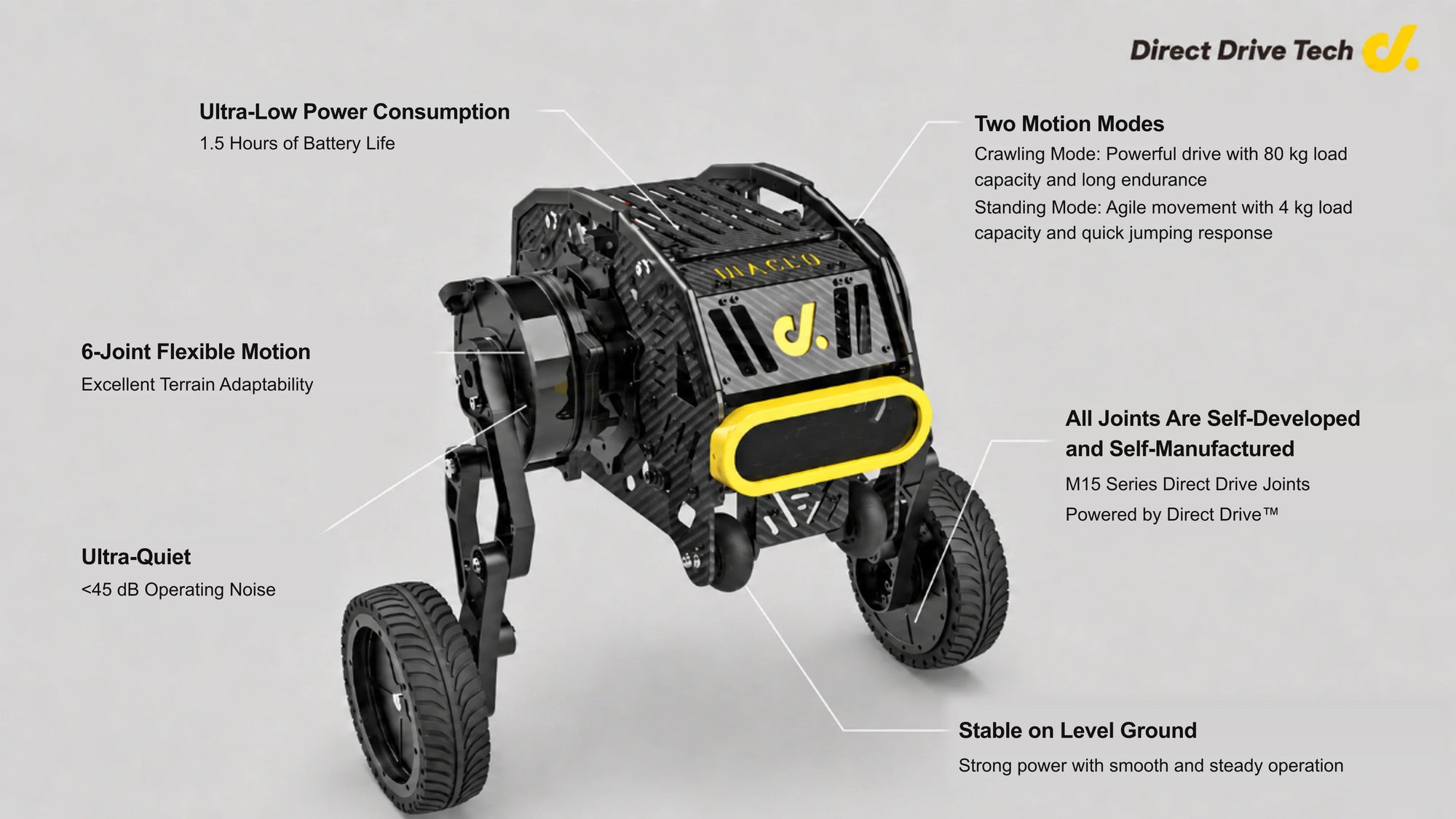
The wheeled-legged robot has become one of the more practical mobile platforms a team can buy today, and the reason is fairly simple. The machine rolls with the speed and efficiency of a wheeled base, while the leg travel underneath gives it a way to absorb steps, slopes and broken ground that would stop a flat-wheeled cart. We have been building this category at Direct Drive Tech since 2020, and over that period we have watched it move out of university labs, into industrial inspection and delivery work, and more recently into product concepts aimed at the living room.
Why the wheel and leg combination keeps attracting research money
The appeal comes down to a trade-off that mobile robotics has lived with for decades. Wheels move faster and use less energy on flat ground, while legs handle terrain that wheels cannot cross. Researchers at ETH Zurich's Robotic Systems Lab described the combination of both strategies as a way to get the best of both worlds. Their published work points at rapid exploration, payload delivery, search and rescue, and industrial inspection as the tasks that benefit most.
That research heritage matters for buyers, because the control problem behind a balancing wheeled-leg robot is genuinely hard. Progress in computer vision, reinforcement learning and motion control over the past decade is what moved these machines from careful lab demonstrations toward field-testable development platforms.
Our own path ran through industrial work first
We took the industrial route deliberately. Our first wheeled-leg platform, Diablo, arrived in 2021 alongside the M06 and M15 motor series. TITA followed in 2023 as an eight-degree-of-freedom wheeled bipedal platform, and D1 arrived in 2025 as a fully modular embodied intelligent robot that switches between bipedal and quadruped locomotion. Most of our engineering team came out of universities and companies including DJI and IBM, and we manufacture in our own factory, which shortens the gap between a customer request and a shipped unit.
In practice, customers use these platforms for inspection and mapping in parks, mines and industrial sites, for security patrol and data collection routes, for short-distance delivery inside a campus, for filming work, and for teaching and secondary development in university labs. TITA and D1 support ROS 2, while Diablo provides an open SDK for custom control and module integration. That openness on the software side tends to be the deciding factor for research teams.
A practical comparison of our three platforms
These figures are our own published specifications, measured under our test conditions with our standard configurations. They describe our products only and should not be read as an industry benchmark or a general standard for wheeled-legged robots.
| Specification | Diablo | TITA | D1 (D-Infinite) |
|---|---|---|---|
| Weight | 22.9 kg | 24.1 kg without battery | 24.3 kg without docking |
| Maximum speed | 2 m/s | 3 m/s, up to 5 m/s by API unlock | 2 m/s bipedal, 3.2 m/s quadruped |
| Payload | 4 kg standing, 80 kg creeping | 10 kg moving payload | 80 kg standing, above 100 kg prone |
| Runtime | Around 3 hours in creeping mode at 34°C ambient | Around 2 hours with hot-swappable batteries | At least 5 hours unloaded, up to 25 km range |
| Compute and development | Raspberry Pi, open SDK | NVIDIA Jetson Orin NX 16GB, ROS 2 | NVIDIA Jetson Orin NX 8GB, Ubuntu 22.04, ROS 2 |
A few details are worth pulling out. TITA manages a 20 cm forward jump and a 30 cm vertical jump. Diablo runs at under 49 dB, which matters in offices and indoor spaces. D1 documents a 70 cm maximum obstacle, though we recommend 50 cm as the safer working figure during evaluation, and that gap between the two numbers is the kind of margin worth discussing before a deployment.
Where this goes next
Our expectation is that the industrial and research market stays ahead of the home and delivery market for the next few years, while home concepts pull the cost curve down for everyone. Teams evaluating a platform now tend to weigh three things above the rest: payload against the sensors they plan to mount, runtime against their patrol route, and how open the software stack is for their own code.
Full specifications, tutorials and SDK documentation for every platform are available at shop.directdrive.com. Teams can contact Direct Drive Tech before ordering to confirm mounting, balance, software integration, and support scope for a specific project.