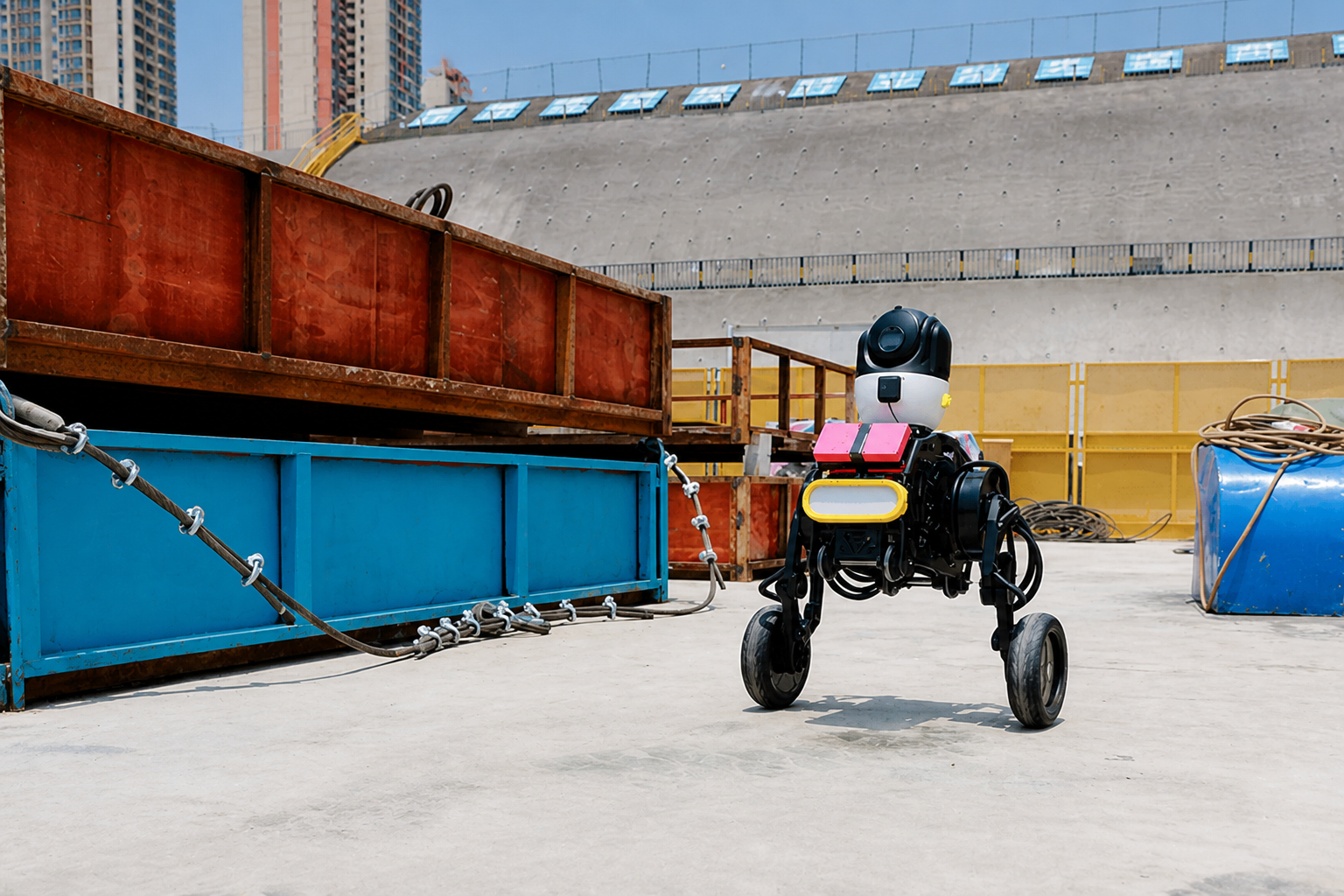
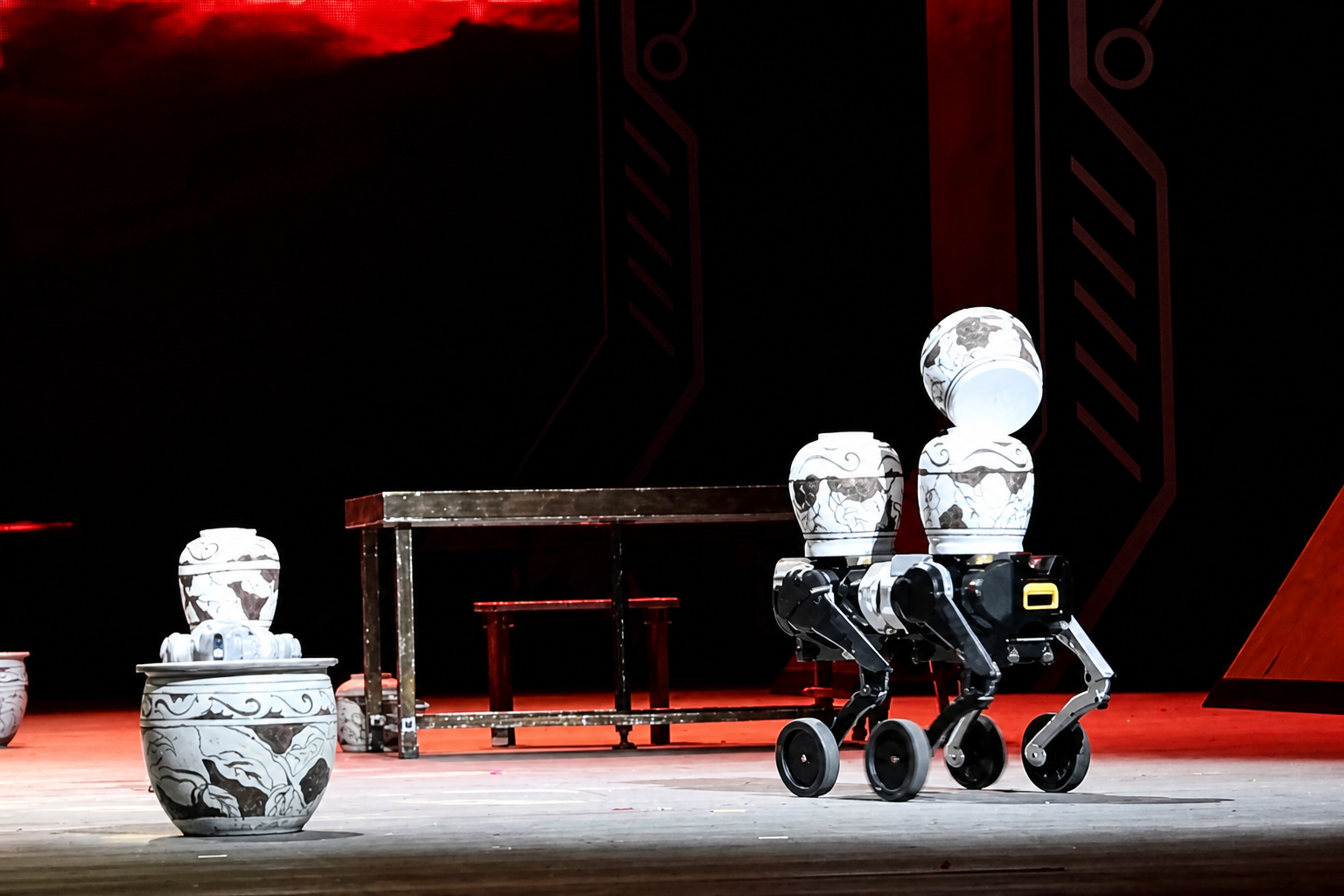
At Direct Drive Tech, we build robots for places where mobility is never as simple as driving in a straight line. Industrial sites have slopes, narrow paths, changing routes, equipment areas, and inspection points that are hard to standardize. An 8-DoF robot gives teams a more flexible way to move through these environments while carrying the sensors and tools needed for real work.
TITA is our 8-DoF wheeled bipedal robot platform. It combines the speed of a wheeled robot with the posture adjustment and obstacle handling of a legged robot, which makes it useful for inspection, mapping, security patrol, delivery experiments, filming, robotics education, and secondary development. Its design has also received professional recognition in the DIA Concept category, reflecting the value of combining industrial usefulness with a clean, integrated robot form.
Why an 8-DoF Robot Matters in Real Work
Degrees of freedom describe how many controlled motion axes a robot can use. For a mobile robot, this affects how it adjusts its body, keeps balance, changes posture, and responds to uneven ground or obstacles.
An 8-DoF robot has more motion flexibility than a simple wheeled chassis. This helps it move across more varied environments, maintain smoother movement, and handle tasks that require both mobility and body control.
In real work, this matters when a robot needs to inspect changing routes, carry sensors, collect data, or support research experiments. Better motion control gives the platform more room to adapt instead of relying only on flat, predictable ground.
Built for Inspection, Mapping, and Data Collection
Industrial inspection work can be repetitive, physically demanding, and hard to keep consistent from one patrol to the next. A mobile robot can help teams collect images, route data, environmental readings, and site information with steadier repeatability across daily operations.
We designed TITA for these real field tasks. It supports a 10 kg moving payload, reaches a maximum speed of 3 m/s, and uses hot swappable batteries that provide up to about 2 hours of running time across two batteries. Each battery lasts about 1 hour under stated conditions, while actual runtime can vary with payload, terrain, and motion profile. These details make TITA practical for teams that need to carry cameras, sensing devices, mapping equipment, or communication hardware during mobile tasks.
TITA’s built-in cameras help operators receive visual information from the robot’s working route. Inertial sensors support posture awareness when the robot is moving, turning, or adjusting its body. SPAD sensors and the ultrasonic sensor help the robot detect surrounding objects, which is especially useful in routes with obstacles, people, equipment, or changing ground conditions.
Remote image transmission makes field inspection easier because teams can see what the robot sees without standing next to the machine. Remote speaker support helps with on-site communication in patrol, reception, and public-facing scenarios. Power-off protection and auto safe stop reduce operational risk when abnormal situations occur, while OTA update support makes maintenance easier as software improves over time. For teams building their own applications, secondary development support turns TITA from a finished robot into a flexible working platform.
Open Interfaces Make TITA Easier to Adapt
A strong 8-DoF robot should leave room for real projects. TITA uses a modular structure and open interface approach so teams can add equipment such as vision modules, communication modules, AI hosts, edge processors, cameras, and other sensors.
The TITA Bridge expansion system supports quick accessory installation with both hardware and software integration. This is useful when a team needs to test a mapping setup one month, a patrol setup the next, and a research payload after that. The same robot body can support different project directions without forcing every team to start from a blank platform.
For teams working with ROS 2, SDK access, and setup workflows, our TITA tutorials and developer manuals provide resources for unboxing, robot operation, user manual access, and Ubuntu development guidance.
A Strong Platform for Research and Education
Universities, laboratories, and robotics teams often need a robot that can handle serious experiments while staying practical enough for daily use. TITA fits this need because it combines mobility, perception, onboard computing, and expansion in one robot body.
The platform uses NVIDIA Jetson Orin NX 16GB computing and supports ROS 2 development. It also provides 100 TOPs AI performance, giving research teams useful room for perception, mapping, decision making, and robotics software experiments. For education, papers, lab demonstrations, secondary development, and competition preparation, this means students and engineers can spend more time building applications and less time assembling a basic mobile robot from scratch.
For a broader view of our mobile robot options, our wheeled robot platform lineup shows how TITA sits alongside other Direct Drive Tech robot platforms for research, inspection, delivery, mapping, and emergency oriented applications.
Direct Drive Thinking Behind the Robot
Our direct drive work shapes how TITA moves, responds, and feels in real operation. By reducing unnecessary mechanical layers between the motor and the robot’s motion, we can make the platform more responsive, more compact, and easier to control as a complete system.
This matters in an 8-DoF robot because smooth motion depends on more than power. It also depends on fast response, natural body adjustment, and hardware that supports precise control. TITA carries this thinking into every movement, from steady driving to posture adjustment, while still leaving room for software development, sensor integration, and custom application design.
Where We See the Future of 8-DoF Robots
We believe 8-DoF robots will become an important part of the next stage of mobile robotics. As industrial sites, research labs, and public service environments ask for platforms that can move faster, adapt better, and carry more sensing capability, robots with flexible motion control will have more room to create practical value.
The future of robotics will be shaped by systems that can collect useful data, understand changing surroundings, and support people in repetitive, complex, or hard-to-standardize tasks. We will continue working toward robot platforms that are easier to develop, easier to deploy, and more useful in real working environments.