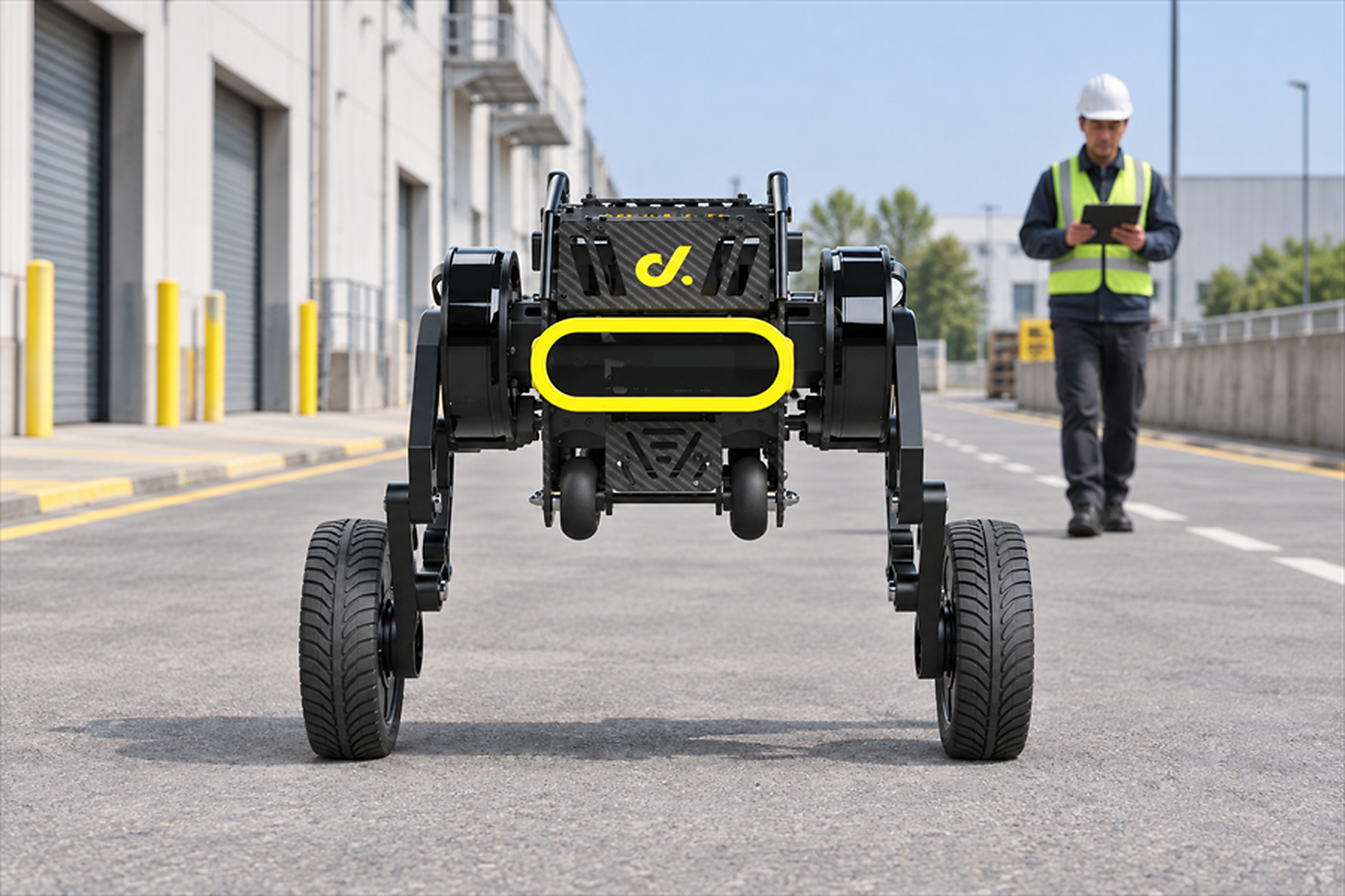
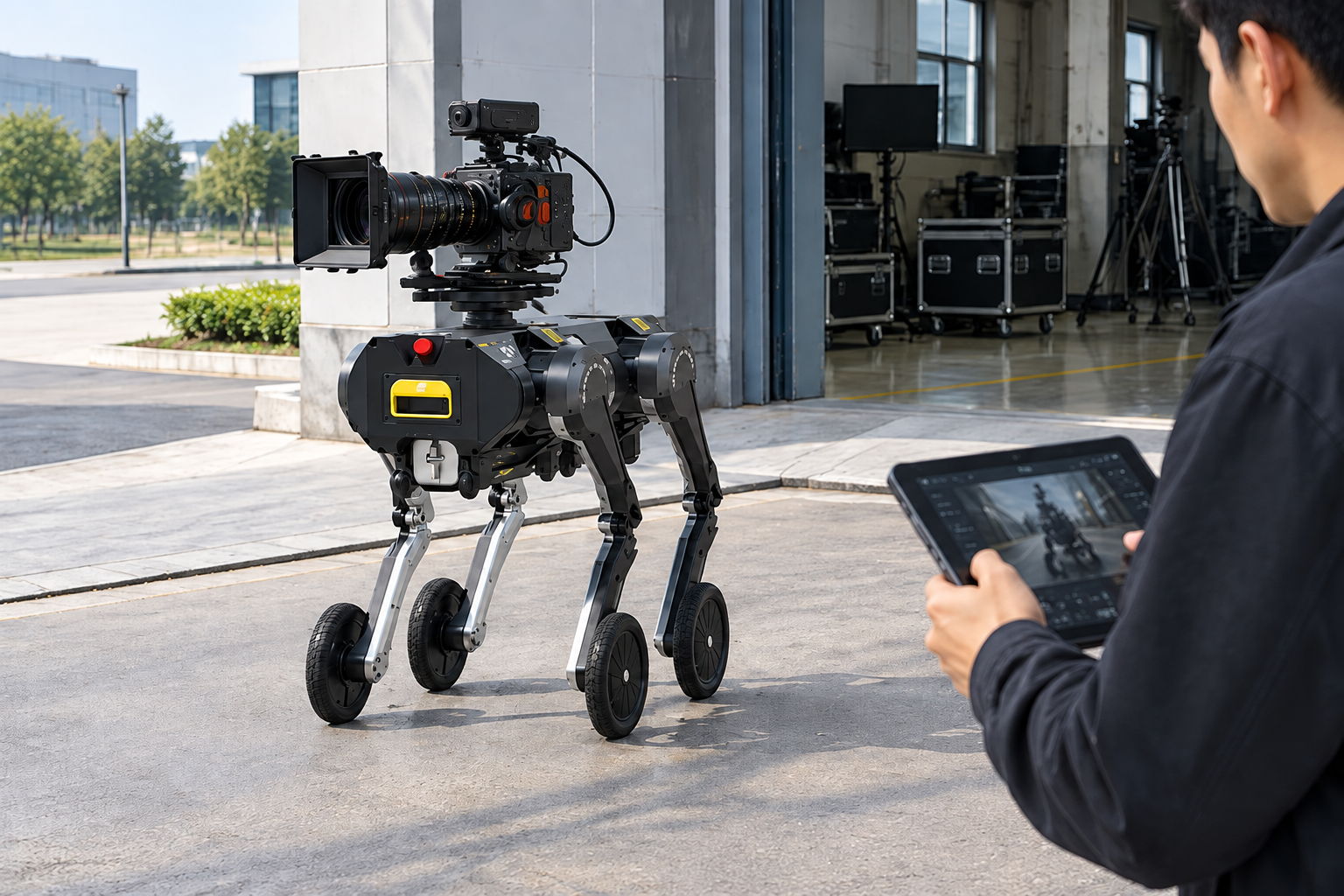
DIABLO is a direct-drive wheeled-leg robot designed to operate in standing, squatting, and creeping configurations. The choice of posture affects the robot’s payload capacity, overall height, sensor placement, and behavior along its intended route.
The following sections explain how DIABLO maintains balance, compare the published specifications for its three configurations—including dimensions, payload limits, and holding-time guidance—and outline how to configure a complete system for its intended route.
How a Direct Drive Robot Maintains Balance as the Ground Changes
Keeping balance involves more than holding one upright pose. A paper co-authored by Direct Drive Technology and Sun Yat-sen University models DIABLO as a simplified second-order inverted pendulum and uses an LQR balance controller. Separate yaw, split-angle, height, and roll controllers coordinate turning, leg alignment, body height, and side-to-side posture.
The same paper reports that DIABLO traversed a 30° slope on a single leg. The controller adjusted leg length and kept roll-angle variation within 0.1 rad throughout the run. The result shows how coordinated height and roll control respond when the wheels encounter different ground heights; it does not establish a universal slope rating for every payload or surface.
Mounted equipment also affects route performance. During turns and threshold crossings, the bracket needs to remain secure while the camera or lidar retains the view required for the task. A stable chassis is useful only when the payload can still provide usable data.
Standing, Squatting, or Creeping: Match the Posture to the Task
| Posture | Published maximum load | Published dimensions, L × W × H | What changes for the project |
|---|---|---|---|
| Standing | 4 kg | 540 × 371 × 491 mm | Upright travel with a lighter equipment package |
| Squatting | Not specified | Not specified | A lower body position with a published holding time of about 15 minutes at 25°C |
| Creeping | 80 kg | 540 × 371 × 270 mm | A lower chassis and a higher published payload limit |
Standing Mode for Lightweight Sensing and Agile Movement
In standing mode, we combine self-balancing travel with body-position adjustment. This posture suits projects involving mobility, sensor positioning, and lightweight equipment.
For integration planning, count the complete added assembly—sensor, computer, bracket, housing, cables and any added battery—against the published 4 kg standing-mode limit. In a mapping configuration, choosing the lidar is only the beginning: account for the complete assembled package before finalizing the mount.
DIABLO can jump about 8 cm without a payload and remain stable while crossing obstacles. For mapping and navigation development, a key consideration is how the fully equipped robot moves along the intended route. Account for every bracket, sensor, cable, and enclosure so the finished assembly fits beneath low overheads and through doorways.
Squatting Posture for Body Height and Clearance
Squatting lowers DIABLO from its full standing height, which can help with overhead clearance or sensor positioning. It can hold this posture for about 15 minutes at 25°C, so posture duration needs to be considered when planning the route.
Creeping Mode for Heavier Loads
In creeping mode, four rollers beneath the body support the platform while the two main wheels propel it. Our maximum load rating for this posture is 80 kg. The lowered body and additional support points create a different load-carrying arrangement from upright balancing.
A transport configuration starts with the cargo footprint, attachment points, and floor conditions. The load should remain secure through starts, stops, and corners. Plan the loaded route around creeping mode, including the space needed to enter and exit each turn.
From a Mobile Platform to a Mapping and Navigation Workflow

DIABLO’s open SDK, top cargo area, and front sensor space make it possible to add perception and computing hardware around a specific task. A successful setup depends on more than finding room for the equipment: weight, power, cabling, and sensor visibility all affect how the robot behaves on the route.
Diablo Saukele shows this approach in practice. Built by a Carnegie Mellon team, the open-source navigation stack combines a Livox Mid-360 lidar, a processing computer, and separate batteries for the upper electronics with SLAM, route and exploration planning, obstacle avoidance, and waypoint following. Teams can begin in a Unity simulation before moving the same workflow to the physical robot. Because this implementation drives DIABLO in standing mode, its sensor layout and payload are designed around that posture.
Physical operation can reveal limitations that a clean simulation may not capture. In the Saukele configuration, 1.2 m of ground immediately ahead lies outside the lidar’s view, so low objects can be missed. The repository also reports occasional SLAM drift that can disrupt the terrain map, obstacle avoidance, and waypoint following. Travel speed, obstacle-height thresholds, and indoor or outdoor planner settings still need to match the site.
For mapping and navigation development, reaching a waypoint is only one part of the workflow. The sensor must also maintain a useful position and provide consistent data throughout the route. DIABLO’s mobility and configurable hardware support navigation, sensor placement, and data collection within the same development workflow.
Route Planning and Operating Considerations
Plan a representative route that includes the narrowest passage, a corner, a stopping point, and any relevant change in floor level. These route features help define the required posture, clearance, speed, and equipment layout.
Record the assembled robot’s dimensions. Note the full width, height, and overhang after fitting the equipment, including the space required while turning. Document mounting positions and weight, and keep cables clear of moving parts and sensor views.
Set a working speed for the task. Our maximum travel speed is 2 m/s, but the operating speed should allow the loaded platform to turn, stop, and collect reliable data safely. Choose a speed appropriate for the route, payload, and surroundings. We specify operating noise below 49 dB; account for on-site sound requirements when the robot will operate in shared indoor spaces.
Coordinate motion and sensing. Configure the camera or lidar to maintain clear coverage as DIABLO approaches thresholds and moves across changes in floor level. Secure the payload, protect sensor visibility, and keep cabling clear throughout the route. The Saukele stack supports point-cloud and trajectory recording for mapping and navigation.
Document the operating configuration. Record software versions, selected posture, speed settings, and mounting layout. Our ROS 2 interface provides motion-command access and IMU and body-state feedback for development work. Keep this information with route records, stopping positions, and notes about any operator intervention.
Define the operating requirements for the route: secure equipment, usable sensor output, and reliable completion of the intended task. Keep the configuration documented so posture, mounting, speed, and software settings remain clear throughout deployment.
Frequently Asked Questions
How Much Equipment Fits Within the Standing-Mode Limit?
The 4 kg standing limit covers the complete added assembly—not only the main sensor. Include the computer, bracket, enclosure, cables, and any auxiliary battery in the payload total.
Does the Platform Include Autonomous Navigation?
Not as a standard, ready-to-run configuration. DIABLO is supplied as a development platform with an open SDK; application sensors and navigation software belong to the integration project. Diablo Saukele documents one implementation built on DIABLO, not a package supplied with every unit.
Is ROS 2 Available for Development?
Yes. Our ROS 2 repository provides motion-control interfaces and examples. Match your operating system and ROS distribution to the documentation for the software branch you plan to use.
Is Squatting a Third Load-Rated Mode?
No. DIABLO’s load ratings apply to standing (4 kg) and creeping (80 kg). Squatting is a controllable posture with an approximate 15-minute holding time at 25°C, not a separately load-rated configuration.
Build the Configuration Around Your Task
For a DIABLO direct drive robot project, start with what the robot needs to carry, where it needs to go, and what it must accomplish along the way. Those details determine the working posture, equipment layout, and software required for the route.
Contact Direct Drive Tech with your payload weight, mounting layout, route conditions, and software requirements to discuss the setup and available support.