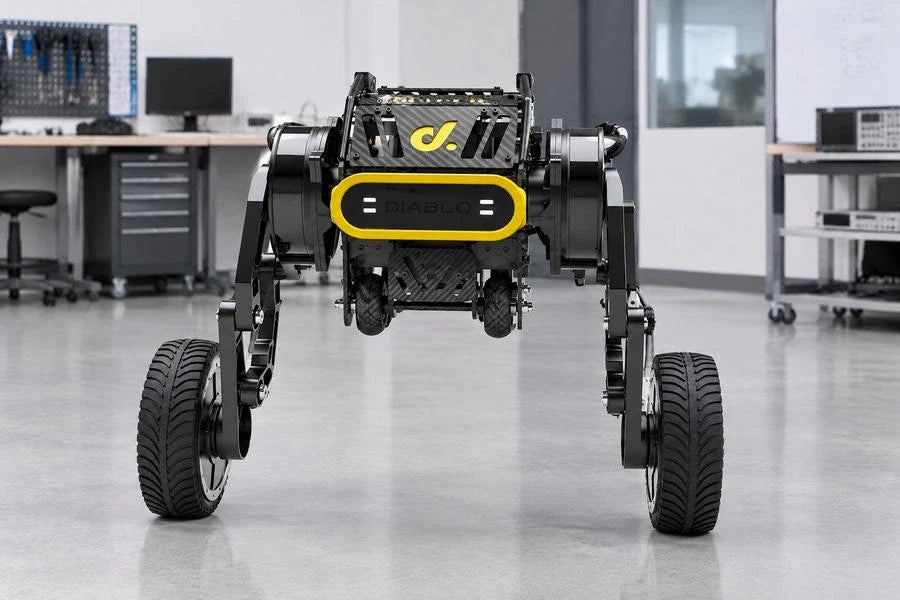
The autonomous mobile robot market is being shaped by AI, stronger autonomy, inspection automation, delivery demand, labor gaps, and rising safety expectations. According to the International Federation of Robotics, the global market value of industrial robot installations has reached US$16.7 billion. AI is helping robots improve route planning, analyze operating data, and support logistics workflows, while mobile platforms are taking on more routine inspection, patrol, mapping, and short-distance delivery tasks.
2026 Trends Shaping Autonomous Mobile Robot Platforms
The IFR global robotics trends report points to AI and autonomy as a major force in robotics. For AMR projects, this means robots are expected to understand routes, process sensor data, support path planning, and respond better to changing work environments. Inspection robots benefit from smarter data collection, while delivery robots benefit from better route behavior and task planning.
Labor gaps are also pushing more companies to look at automation for routine work. Site checks, patrol routes, mapping tasks, and short-distance transport can place pressure on teams when skilled workers are limited. Robots can help take on repetitive movement and data collection, giving staff more space to focus on judgment, maintenance, and decision-making.
Safety and security are becoming more important as robots work closer to people, equipment, and connected systems. Every project needs a safety review based on route, speed, payload, sensors, local rules, and intended use. Open development support also matters. ROS 2, APIs, SDKs, tutorials, and documentation help AMR teams build, test, and adjust the robot around real workflows.
Why Platform Choice Matters for Inspection and Delivery Robots
Movement alone is a limited way to judge an autonomous mobile robot platform. A strong AMR base also needs payload capacity, runtime, sensor expansion, software access, and support for secondary development. These details decide whether the robot can carry useful hardware, collect the right data, and keep improving through repeated tests.
Our wheeled robot platforms are designed for research, education, inspection, mapping, security patrol, delivery, emergency rescue, and filming applications. This gives customers a flexible starting point for route validation, sensor mounting, data collection, delivery experiments, and software development. A capable platform helps teams move from concept testing to practical application with fewer hardware changes.
Inspection Robots Need Stable Mobility and Sensor Expansion

Inspection robots need steady mobility because data quality depends on how confidently the robot moves. A robot may travel through industrial routes, mine areas, park paths, warehouse aisles, or campus spaces while carrying cameras, mapping equipment, or other sensors. Smooth movement, stable structure, and reliable expansion make inspection work easier to test and easier to trust.
Our TITA robot platform is built for inspection, mapping, security patrol, delivery experiments, filming, robotics education, and secondary development. TITA uses an 8 degree of freedom wheeled bipedal structure and combines onboard NVIDIA Jetson Orin NX computing, ROS 2 support, SDK access, full-link API support, and TITA Bridge expansion. For camera and 3D mapping projects, TITA Bridge and TITA Tower give teams a practical path for accessory integration, with final sensor fit reviewed around each project.
TITA is especially useful for teams that need a compact and agile AMR platform for patrol routes, mapping tests, visual data collection, and mobile sensing. It can support campus security patrol, industrial site checks, warehouse route inspection, park mapping, filming, robotics education, and early-stage delivery experiments. Its 10 kg moving payload gives room for cameras, mapping accessories, small compute modules, and test equipment when mounting and balance are confirmed.
Hot-swappable batteries support about 2 hours of runtime, with about 1 hour per battery depending on load and motion. This helps inspection teams continue route testing, data collection, and software tuning with fewer long pauses. For teams building their first inspection robot workflow, TITA offers a strong mix of mobility, payload, software access, and real application flexibility.
Delivery Robots Need Payload, Runtime, and Adaptability

Delivery projects may look straightforward in the beginning, but every real site brings its own details. The robot has to carry items safely, stay steady while moving, adapt to different routes, and leave enough space for testing boxes, trays, sensors, and docking setups. A strong base platform helps teams adjust the delivery workflow more easily as the project moves forward.
Our D1 robot platform is built for teams that need a more powerful and modular AMR base. D1 combines bipedal and quadruped locomotion, Ubuntu 22.04 with ROS 2 support, and expansion options for robotic arms, depth cameras, LiDAR, large wheels, and OTA updates. This makes D1 a strong choice for delivery experiments, field robotics, inspection routes, security patrol, emergency rescue evaluation, and logistics research.
D1’s payload capacity gives teams serious room for heavier testing. In its quadrupedal configuration, the platform supports an 80 kg standing payload and more than 100 kg prone payload under the stated product conditions. These are posture-specific ratings, not moving-payload ratings. The quadrupedal configuration also supports at least 5 hours of no-load runtime and up to 25 km range under no-load conditions. For delivery robot development, that means more space to test cargo structures, perception hardware, route behavior, delivery experiments, logistics testing, and field robotics evaluation.
Where DirectDrive Platforms Fit in Real AMR Projects
DirectDrive platforms are designed for teams that need a practical path from idea to field testing. TITA is a better fit when the project needs agile movement, compact size, mapping accessories, camera-based inspection, security patrol, filming, or robotics education. D1 is a stronger fit when the project needs higher payload, longer route testing, field robotics evaluation, delivery experiments, robotic arm expansion, depth camera integration, LiDAR, and more demanding mobility research.
This gives AMR teams a clearer product path. A lab can start with TITA for fast inspection and mapping tests, then move to D1 when the project needs heavier payloads or more complex locomotion. A delivery team can use D1 to test cargo structures, route behavior, docking setups, and perception hardware. A security or inspection team can use TITA for patrol routes, visual data collection, and sensor-based site checks. The goal is to help each team choose a robot platform around the job they want to build.
TITA vs D1: Choosing the Right Autonomous Mobile Robot Platform
| Compare by | TITA | D1 |
|---|---|---|
| Best for | Inspection, mapping, security patrol, filming, education, and mobile data collection | Delivery experiments, field robotics, emergency rescue testing, inspection routes, and multi-locomotion research |
| Payload | 10 kg moving payload | Quadrupedal configuration: 80 kg standing payload and more than 100 kg prone payload under stated product conditions. These are posture-specific ratings, not moving-payload ratings. |
| Runtime / range | About 2 hours with hot-swappable batteries, about 1 hour per battery depending on load and motion | Quadrupedal configuration: at least 5 hours no-load runtime and up to 25 km no-load range |
| Expansion options | TITA Bridge, TITA Tower 3D mapping, robotic arm modules, and supported accessories | Robotic arm, depth camera, LiDAR, large wheels, and OTA updates |
| Development support | SDK access, full-link API support, open Linux kernel source, and ROS 2 support | Ubuntu 22.04, ROS 2 support, and development resources for navigation, perception, and secondary development |
| Suitable applications | Inspection, mapping, security patrol, short-distance delivery experiments, filming, and research labs | Inspection, security patrol, short-distance delivery, logistics experiments, emergency rescue, and field robotics testing |
Development Support for AMR Teams
AMR teams need more than hardware. Clear documentation, software references, tutorials, API access, and SDK resources can make testing much easier. We provide setup and development resources, including D1 tutorials and development documentation, so teams can work through unboxing, manuals, Ubuntu development documentation, and secondary development tasks with better structure.
ROS 2 support is valuable because many robotics teams use it to connect navigation, perception, control, and application logic. API and SDK access help engineers tune robot behavior, connect accessories, and test custom workflows. For inspection and delivery robots, this kind of openness can shorten the path from platform setup to working application tests.
FAQ About Autonomous Mobile Robot Platforms
What is an autonomous mobile robot platform?
An autonomous mobile robot platform is the mobile base, structure, computing support, expansion path, and development access used to build robots for inspection, mapping, delivery, patrol, research, and other mobile automation tasks.
How do we choose an AMR platform for inspection?
Inspection projects should focus on stable mobility, sensor expansion, payload, runtime, software access, and the ability to support cameras, mapping accessories, or other site-specific hardware.
What matters most for delivery robot development?
Delivery robot development depends on payload, runtime, balance, mounting space, route adaptability, sensor options, and enough flexibility for repeated testing of cargo structures and docking setups.
Why is ROS 2 important for AMR development?
ROS 2 gives robotics teams a familiar framework for navigation, perception, control, testing, and secondary development. It helps engineers build robot workflows with a clearer development structure.
Can one robot platform support both inspection and delivery testing?
Yes. A platform with stable movement, payload capacity, sensor expansion, and software access can support both types of testing. TITA is well suited to inspection, mapping, and patrol-focused work, while D1 gives teams more payload and modular room for heavier delivery and field robotics projects.
Autonomous mobile robot projects are becoming more practical as teams ask sharper questions about payload, movement, runtime, expansion, software access, and safety planning. At DirectDrive, our goal is to help inspection and delivery teams build from a stronger platform, test with better structure, and move closer to real-world automation.