When we plan a mobile shoot, the challenge is rarely just moving a camera from one point to another. We need to carry a complete camera package, keep the rig stable, adapt when the route changes, and reach angles or locations that may be difficult for a conventional camera platform. A fixed camera base can restrict the shot, while an overly simplified setup may force us to leave behind lenses, support equipment, monitoring tools, or sensing hardware needed on set.
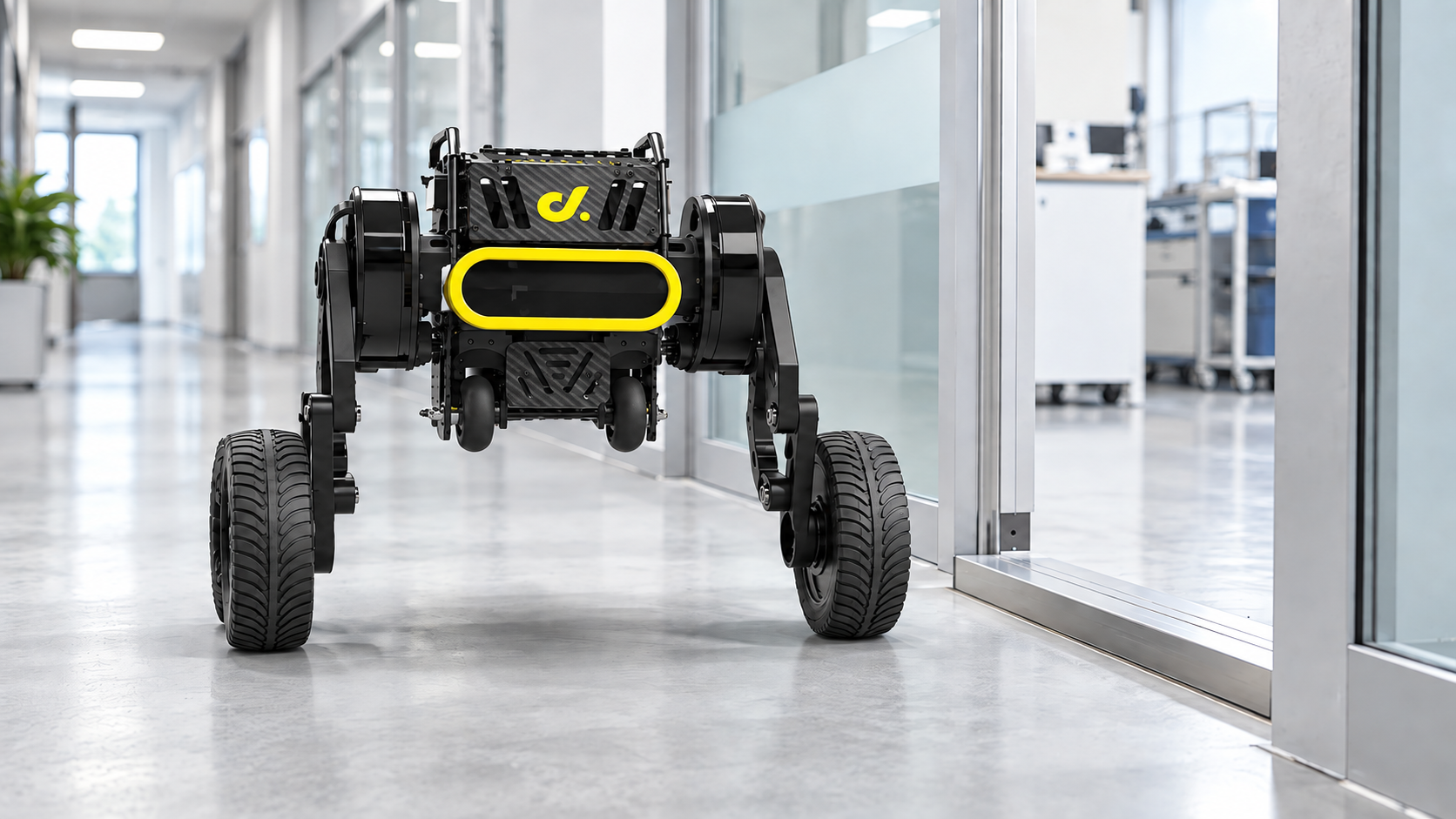
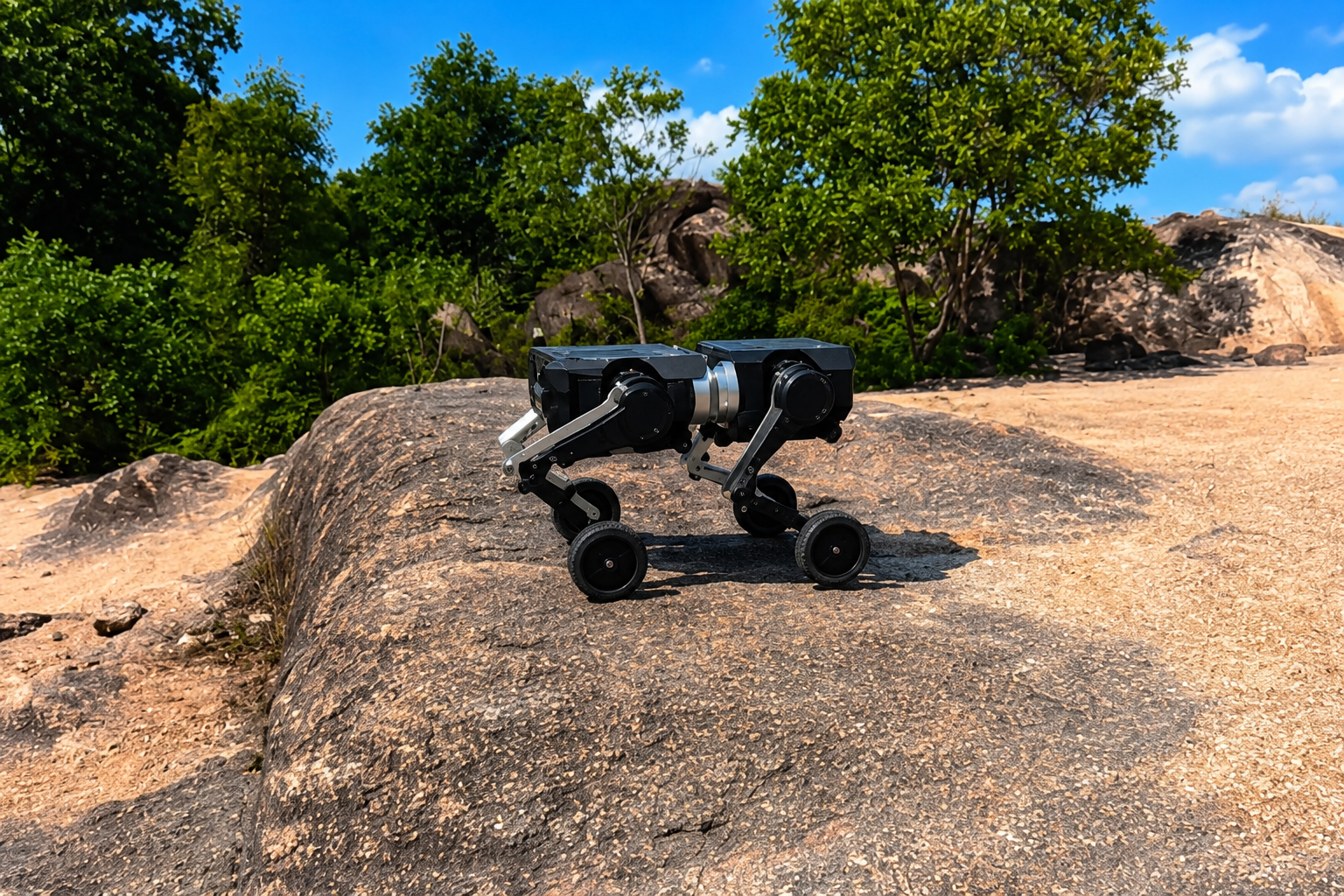
We built our D1 robot as a fully modular mobile platform to address these practical challenges. Its configurable wheel- and leg-based movement gives us more ways to test camera motion across studio floors, outdoor paths, slopes, uneven ground, and changing site conditions. This lets us plan the camera package and movement route together while leaving room for additional equipment and future development.
Why D1 Robot Fits Mobile Filming
Our D1 robot fits mobile filming because we can use it to carry and test a complete camera setup while adapting its movement to different routes and surfaces. Its modular design supports changing camera positions, outdoor mobility tests, and additional sensing equipment within one platform.
A filming route may begin on a smooth studio floor and continue across an outdoor path, slope, or uneven surface. D1 robot supports different wheel- and leg-based movement forms, giving us more flexibility when the location or camera angle changes. We plan the selected configuration around the route, payload, ground conditions, and required movement profile.
Our D1 robot reaches a maximum speed of 2 m/s in bipedal mode and 3.2 m/s in quadruped mode. These figures provide a starting point for planning moving shots and on-site camera tests. Final performance depends on equipment load, terrain, movement settings, and the safety controls used at the filming site.
How Modular Locomotion Changes a Camera Route
Modular locomotion gives a camera route more flexibility when the ground, elevation, or available clearance changes. A conventional wheeled base performs well on smooth and predictable surfaces, while filming locations may include thresholds, uneven ground, temporary equipment, and sloped sections. These conditions can change both the robot’s path and the camera position.
D1 robot supports flexible movement testing through its wheel- and leg-based architecture. It has a maximum obstacle capability of 70 cm, with 50 cm set as the recommended operating obstacle. We use the 50 cm figure as the practical planning reference when assessing payload, surface condition, movement speed, and clearance around the route.
Before production use, our team tests the complete robot and camera configuration in conditions close to the intended shoot. Slopes, loose ground, narrow spaces, and nearby crew members all require careful route planning and appropriate safety controls.
More Camera Positions for Location Work
A configurable mobile platform gives us more options for location filming. With the right mount and robot configuration, we can explore low-angle tracking, parallel movement, leading and following shots, continuous indoor-to-outdoor routes, and remote camera views in narrow or hazardous areas. We validate each movement with the final camera package, route, and safety controls before using it in production.
How We Size the Camera Payload
We size the complete filming setup rather than treating the camera body as the entire payload. A complete package may include a cinema camera body and lens, a gimbal or custom mount, follow-focus equipment, wireless video and communication hardware, independent batteries, protective housing, and additional sensors such as a depth camera or LiDAR.
With an 80 kg standing payload and more than 100 kg in the prone configuration, our D1 robot gives us room to plan the complete camera system instead of evaluating each component separately. This helps us avoid over-simplifying the camera package just to fit the robot’s carrying capacity. Final payload placement, mounting height, center of gravity, cable routing, and movement configuration should be verified with the intended setup.
D1 robot weighs 24.3 kg without docking and 48.5 kg with docking. These figures help us plan transport, loading, setup, and on-site handling. Before filming, we also check the center of gravity, mounting height, cable routing, movement posture, and route conditions to keep the complete setup stable and practical.
Connecting Camera Motion with Sensing and Software
For projects that connect camera movement with software and sensing, D1 provides a practical development base. The platform combines an NVIDIA Jetson Orin NX computing platform with Ubuntu 22.04 and ROS 2 support. We can use this setup to connect robot motion with camera control, remote monitoring, route planning, depth cameras, LiDAR, and other perception modules.
We can develop sensor-assisted camera routes, preset movement tests, and repeatable motion experiments on this platform. These workflows help us explore automated filming and camera control for specific production needs. Actual accuracy and repeatability depend on the software, calibration, payload, surface, and selected control system.
| Area | D1 robot specification | Our planning perspective |
|---|---|---|
| Compute platform | NVIDIA Jetson Orin NX 8GB | We use the computing foundation for perception, navigation, robot control, and application development. |
| Operating system | Ubuntu 22.04 with ROS 2 support | We use this software environment when we connect robot movement with camera and sensing workflows. |
| Interfaces | 2 x USB-C, 1 x Ethernet, and 1 x charging port | We evaluate these interfaces when planning camera control, monitoring, communication, and sensor integration for a specific setup. |
| Movement speed | 2 m/s in bipedal mode and 3.2 m/s in quadruped mode | We select the movement mode according to the route, payload, camera motion, and safety requirements. |
| Payload | 80 kg standing payload and more than 100 kg prone payload | We use the load information to plan the camera, mount, sensing equipment, and communications hardware together. |
| Battery | 43.2 V, 9 Ah, 388.8 Wh | We use these values when estimating the power requirements of a complete filming setup. |
| No-load runtime and range | At least 5 hours of no-load runtime and up to 25 km range | We use these figures as planning references for extended outdoor mobility tests. |
| Obstacle capability | 70 cm maximum obstacle and 50 cm recommended operating obstacle | We use 50 cm as the practical route planning reference and reserve the maximum figure for controlled evaluation. |
| Charging time | Less than 2 hours | We include charging time when arranging test sessions, equipment changes, and field breaks. |
What D1 Robot Brings to Field Testing
These specifications describe D1 robot under the stated product conditions. We treat them as product references rather than universal standards for mobile camera robots. Final suitability depends on the selected camera equipment, mounting method, environment, operating plan, and the latest datasheet.
Why Extended Runtime Matters on a Filming Site
Longer no-load runtime helps us keep a field filming session moving. Our D1 robot supports at least 5 hours of no-load operation and up to 25 km of range, so we can plan longer route scouting, movement tests, and more repeated takes within one session before recharging.
These figures apply to no-load operation. A camera, sensor, communication system, or other equipment will change power consumption, so we test the complete configuration before setting a production schedule. With a charging time of less than 2 hours, equipment changes and additional route tests can be planned with fewer interruptions.
How We Prepare the First Mobile Filming Test
A reliable first filming test starts with two practical questions. What camera package will the robot carry, and what route will it follow? Camera weight, lens choice, mounting height, power supply, cable routing, communication method, movement posture, surface condition, and operator controls all shape the final setup.
Before production use, we test the complete robot and camera configuration in conditions close to the intended shoot. A setup that moves smoothly across a studio floor may need different settings outdoors. Early trials give us time to adjust the camera mount, payload position, sensing equipment, and route plan.
Our D1 robot tutorial and development resources include robot tutorial videos, the user manual, and Ubuntu system development documentation. These materials support software development, payload integration, and on-site preparation.
How We Use D1 Robot Beyond Filming
We use D1 robot for more than mobile filming. The same modular platform also supports our work in research and development, security inspection, short-distance delivery, emergency rescue evaluation, and robotics demonstrations.
For filming teams, this broader application range leaves room for future development. A platform first used to test moving camera shots can later support perception research, inspection demonstrations, mapping experiments, or embodied AI development. New modules can be added as the project requirements change.
Our expansion options include a robotic arm, depth camera, LiDAR, large wheels, and OTA updates. We also offer stereo GMSL2 camera hardware for stereo vision, depth sensing, and robot environment perception.
We treat this type of stereo camera as the robot’s eyes rather than as the main camera for finished footage. Combined with the Jetson platform, it can provide visual data for distance, route, and surrounding-environment assessment and support development of route planning, mapping, or intelligent following in research, automation, and virtual production projects. Before integration, our team checks the interface, mounting method, cabling, driver support, and compatibility with the selected D1 robot setup.
For a mobile filming project, contact our robot team with the camera equipment, payload requirements, route conditions, movement goals, and development plan. We can then help select a D1 robot configuration that fits the project.