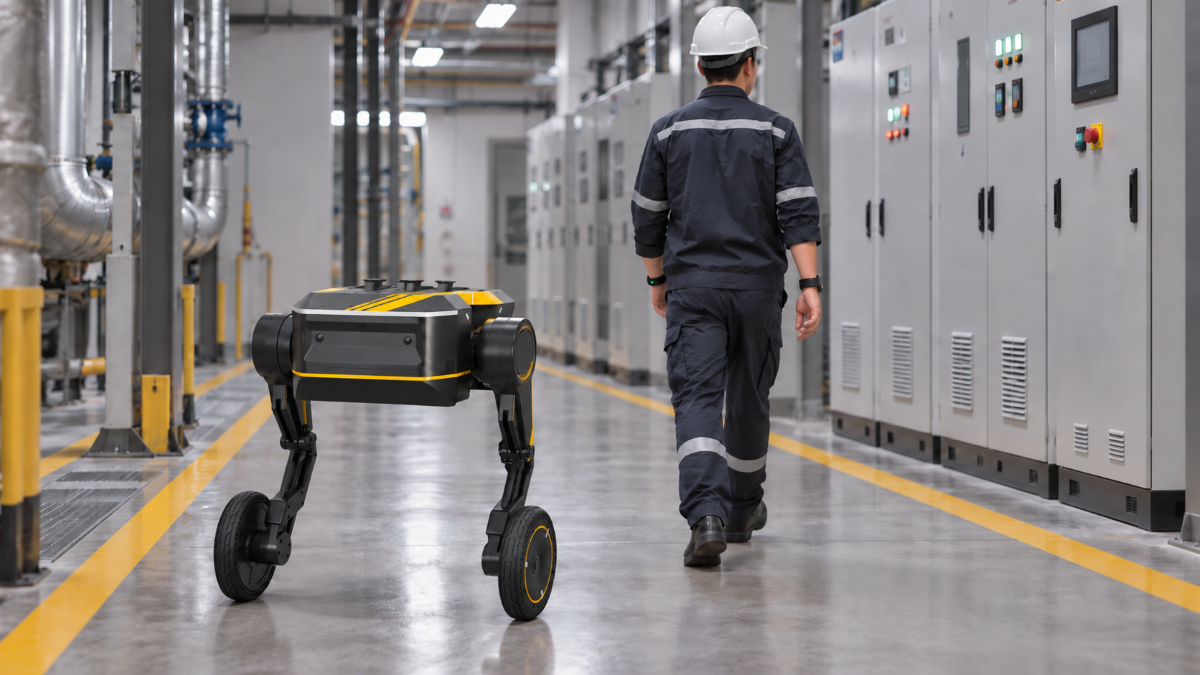
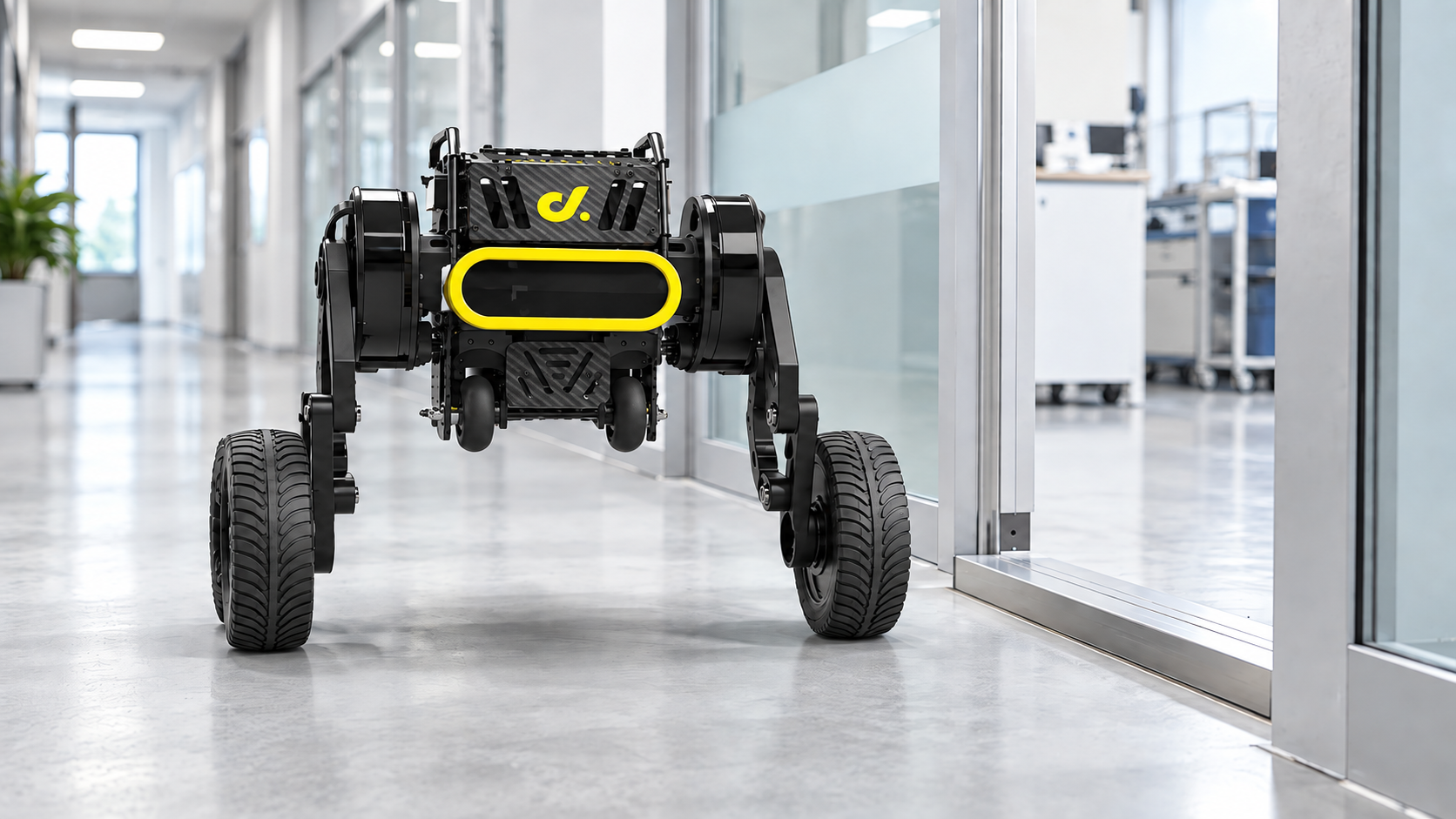
DIABLO’s unique wheeled-leg appearance came from a practical engineering decision: combining wheels for efficient floor travel with articulated legs for balance, height, and posture adjustment. Its form was shaped by the need to balance movement efficiency with physical flexibility, not by an attempt to imitate a particular animal.
From an Engineering Question to Direct Drive Tech
While studying robot power systems and control at the Hong Kong University of Science and Technology under Professor Li Zexiang, our founder Di Zhang began exploring whether a robot joint could deliver the required torque and control response without relying on a conventional reduction gearbox. That exploration became the technical foundation of our reducer-free actuator technology.
Removing the reducer changes more than the joint’s mechanical layout. It eliminates gear-mesh backlash and shortens the transmission path, creating a more direct relationship between motor output and control commands. As described in our published technical paper on DIABLO, this architecture reduces transmission-structure losses and supports high control bandwidth. Actual drivetrain efficiency and operating time still depend on motor sizing, current demand, thermal limits, payload, control strategy, and operating conditions.
DIABLO applies this principle through six M1502D direct-drive joints. Its drive system combines field-oriented control with integrated angle sensing to manage motor torque, position, and speed without an intermediate gear train. Once the drivetrain architecture was established, the next question was what kind of mobile platform could use it effectively.
How DIABLO Took Its Wheeled-Leg Form
Direct drive answered how DIABLO’s joints should move; the wheeled-leg layout answered where and how the robot should move. We wanted the efficiency of wheels on prepared surfaces without giving up balance, ride-height adjustment, and posture control. That requirement—not an attempt to imitate a particular animal—produced DIABLO’s distinctive form: two articulated legs, a wheel at the end of each leg, a raised central body, and six integrated direct-drive joint modules.
Direct drive made this layout practical. The joints respond quickly as DIABLO accelerates, brakes, changes height, or recovers from a disturbance, without introducing gear-mesh backlash. Packaging actuation, drive control, and feedback into each module also reduces the integration work for chassis developers.
The flange-mounted joints can be replaced as complete modules instead of requiring a gear train rebuild. This simplifies maintenance and can reduce downtime for research platforms and integration projects.
What DIABLO’s Wheeled-Leg Design Enables in Practice
Together, the direct-drive joints and wheeled-leg layout define what DIABLO can do in practice. Its wheels support efficient travel, while its articulated legs provide active balance, obstacle handling, body-height adjustment, and posture control. The result is a configurable mobile platform for offices, laboratories, campuses, and other structured or semi-structured environments, with additional adaptability for rough roads and small obstacles. Actual performance depends on terrain, payload, posture, and operating conditions.
DIABLO travels at up to 2 m/s and operates below 49 dB. Standing mode supports a published maximum payload of 4 kg for agile movement, while Creeping mode lowers the body onto additional support rollers and is rated for loads of up to 80 kg. These figures describe different mechanical configurations and should not be treated as interchangeable payload ratings. Runtime also varies with posture, speed, payload, terrain, duty cycle, and ambient temperature. See the complete DIABLO operating specifications for the relevant test conditions and limits.
Material Transport on Prepared Routes
Documents, samples, and small components often need to move between offices, laboratories, and test areas. DIABLO’s wheeled mobility makes it suitable for evaluating these routine transport tasks, while its upper platform provides a mounting surface for cargo or application hardware. Integrators should validate payload distribution, restraint, center of gravity, route conditions, and stopping behavior for each configuration.
Robotics Research and Secondary Development
For research and secondary development, DIABLO provides control interfaces, feedback data, ROS 2 resources, and supporting documentation. Teams can integrate additional hardware and conduct experiments in balance control, motion planning, navigation, human–robot interaction, or teleoperation without first building a self-balancing mobile base from the ground up.
DIABLO can also support robotics demonstrations and application prototyping in laboratories, classrooms, exhibitions, and other controlled environments. Our prototype demonstration shows the robot maintaining balance while changing its body orientation and performing dynamic movements. Developers can use these demonstrated mobility and balance-control capabilities as a foundation for testing new control strategies and higher-level robotic behaviors.
Conclusion: Form Followed the Engineering Problem
DIABLO’s appearance is the visible outcome of a sequence of engineering decisions. Wheels provided efficient movement on prepared surfaces; articulated legs added balance, height adjustment, and posture control; and direct-drive joints gave the controller a responsive mechanical interface without an intermediate gear train.
From Di Zhang’s early experiment with removing a reducer to the finished wheeled-leg platform, each part of DIABLO’s form reflects the problem it was designed to solve. Its distinctive appearance is therefore not the starting point of the design—it is the visible result of the drivetrain, mobility, and control requirements coming together.
For DIABLO specifications, configuration options, or development support, contact our team.