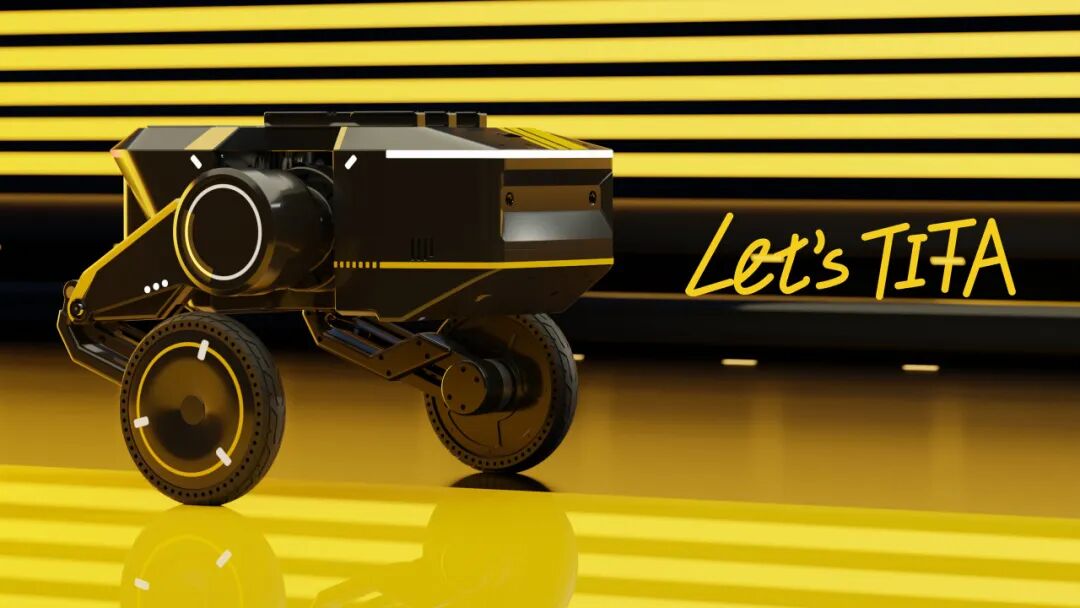
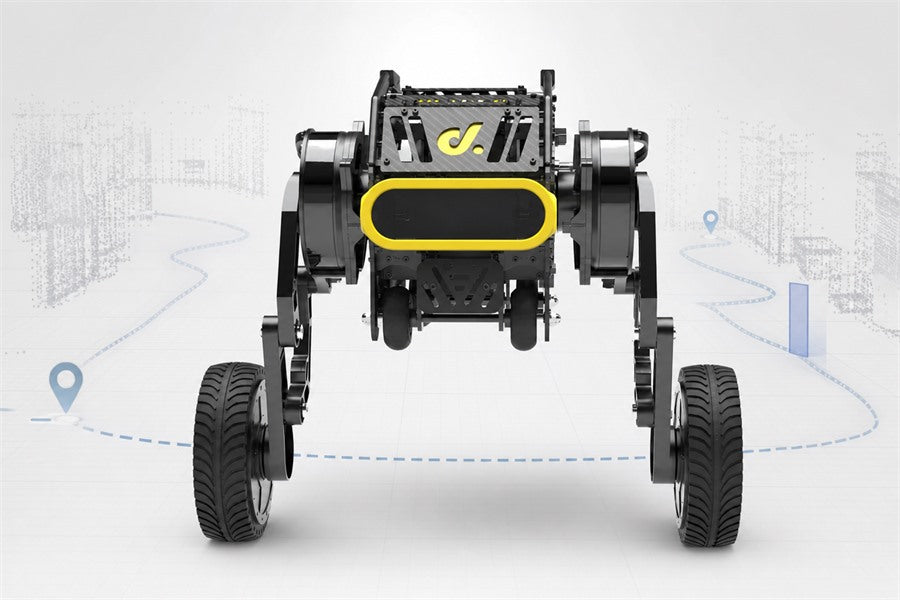
In a live stage collaboration at the Shandong Robot Spring Festival Gala, Direct Drive Tech’s D1 modular embodied robot joined Tan Sancai, a jar-based acrobatic performance by the Jining Acrobatic Troupe.
The stage gave D1 more than a simple showcase. It placed the robot in a human-robot collaboration scene where timing, spacing, stability, and controlled movement all mattered. During the performance, D1 carried jar props, moved between performers, switched between four wheel-legged and two wheel-legged forms, and completed separation and docking actions without breaking the rhythm of the program.
For D1, the value of this scene was not only the performance itself. It showed how modular design, group control, integrated joint modules, and expandable hardware can support mobile robotics applications beyond a lab demo.
Human-Robot Performance in Tan Sancai
Tan Sancai comes from the traditional jar-playing culture of the Yellow River region. The Jining Acrobatic Troupe has developed it into a modern acrobatic work built on balance, timing, and demanding body control. Bringing D1 into this program added a new technological layer to the performance. In a choreographed stage setting, the robot needed to follow the rhythm of the act, share space with performers, and support the movement without interrupting the flow.
On stage, D1’s role was not only to appear as a robot, but to become part of the performance structure. Its carrying, movement, form switching, separation, and docking actions were arranged around performer cues and stage timing. This made the program a useful demonstration of modular wheel-legged robotics in a human-centered performance space, where stability, form adaptation, and coordinated movement all need to work together.
Modular Connection Rebuilds Robot Shape Freedom
D1’s “shape transformation” on stage was a direct expression of our modular connectable product design. It also reflects how we understand robot shape freedom. As a fully modular embodied intelligent robot, D1 breaks through the limits of traditional fixed-form robots and builds its core value around on-demand reconfiguration and flexible adaptation.
- Full-form connection capability. D1 supports wheel-legged to wheel-legged, legged to legged, and wheel-legged to legged combinations. The robot can switch forms according to the scene, just as it adjusted its body for different parts of Tan Sancai.
- High compatibility for expansion. D1 uses an open interface design and can carry vision modules, communication modules, and different sensors. This supports precise interaction on stage and also gives room for customized tasks in industrial inspection, emergency rescue, and other application fields.
- Efficient coordinated operation. With our “general cerebellum” control technology, connected modules can coordinate force output at millisecond level, while separated dual units can also work together with precision. This helps the system deliver stronger combined efficiency.
The product logic behind this modular design is our continued work on a more universal robot base. Traditional robots are often developed for a single scenario, which can increase development cost and reduce adaptability. D1’s modular architecture supports core module reuse and scenario-based expansion, helping reduce the cost of development and application while creating a stronger foundation for scaled production.
D1 Is Our Modular Embodied Robot Platform

The D1 robot platform is built for embodied AI labs, robotics research, inspection, delivery, emergency rescue evaluation, filming, demonstrations, and multi-locomotion development. Many teams can make a robot move in a lab, but struggle when the same platform needs to run software, carry sensors, and adapt to a real task. D1 gives that work a stronger base with Ubuntu 22.04, ROS 2 support, and an NVIDIA Jetson Orin NX 8GB compute platform.
For projects that need cameras, LiDAR, larger wheels, or a robotic arm, D1’s expansion options reduce the need to rebuild around every new test. Teams can start with locomotion and control, then add task hardware as the application becomes clearer.
D1 also gives teams more room for payload and route planning. It supports 80 kg standing payload and more than 100 kg prone payload, reaches up to 2 m/s in bipedal mode and 3.2 m/s in quadruped mode, and offers at least 5 hours of no-load runtime with up to 25 km of range.
For outdoor trials or uneven routes, D1’s maximum obstacle capability is 70 cm, with 50 cm as the recommended operating obstacle. We use the recommended value as the practical planning reference because payload, surface condition, speed, and safety margin can all change field performance.
Integrated Joint Modules Support the Flexibility Breakthrough
D1’s modular connectable design and our integrated robot power modules work together. This combination is what allows D1 to achieve a larger step forward in flexibility. Modular design gives the robot a changeable body, while integrated joint modules provide the motion control needed to make that body move with stability and precision.
The collaboration between D1 and the Jining Acrobatic Troupe in Tan Sancai verified this technical combination in a demanding human-robot scene. D1 was able to support more than standardized movement. It adapted to a personalized stage collaboration where timing, space, payload, and performer movement all changed during the act. In four-legged form, D1 offered stronger stability and load capacity for larger movements. In two-legged form, its compact body allowed it to pass through stage corners and interact more precisely with performers.
This flexibility is also our practical interpretation of embodied intelligence. The modular structure builds a flexible body. The integrated joint modules act as precise motion nerves. Each module can support its own movement needs while still contributing to coordinated group behavior.
Compared with traditional fixed-form robots, D1’s improvement can be seen in two areas. The first is motion freedom. Modular connection gives the robot more movement forms, while high-precision joint control helps each action stay smoother and more accurate, including turning, avoidance, jumping, and other complex movements. The second is environmental adaptability. From a flat gala stage to more complex outdoor terrain, D1 can adjust its form and joint behavior to better match different operating needs.
From Stage Demonstration to Real Product Applications
D1’s appearance in Tan Sancai gave us a clear way to show modular embodied robotics outside a lab setting. It carried props, changed form, separated and reconnected, coordinated timing, and worked with performers in a fast-moving shared space. The stage made D1’s flexibility visible, while the product value extends into broader robotics work.
Embodied intelligence is becoming an important direction for robotics, and we see modular design, integrated modules, and group control as key paths for product development. With D1, these technologies are built into one platform that can move from performance scenes into home service, industrial work, logistics, medical support, research, filming, and field robotics.
For more product information and comparison, teams can visit our robot product collection. Our D1 tutorials page also provides detailed guidance on D1, including tutorial videos, the user manual, and Ubuntu development materials.
For us, D1 represents a clear product direction. A useful embodied robot should adapt its structure, keep movement controlled, and support cooperation between connected or separated modules. We will continue developing core robot technologies and working with partners across the supply chain to support the practical growth of embodied intelligent robots.