Anyone who has watched a mobile robot clip a chair leg knows where the real difficulty sits. Moving is the easy part. Understanding the space around the machine is the hard part, and that is usually where an autonomous robot navigation project either takes off or quietly stalls. We build wheeled bipedal platforms at Direct Drive Tech, and perception is the piece our team spends the most time getting right, because everything downstream depends on it.
Good navigation begins with seeing in three dimensions
A flat picture of a room tells a robot very little. A doorway and a painting of a doorway look much the same to a plain camera. What a self-navigating machine actually needs is depth, meaning a live sense of how far away each surface is and whether the floor ahead keeps going. Once that depth information exists, path planning, localization and obstacle avoidance all become tractable. Without it, even a very powerful onboard computer ends up guessing.
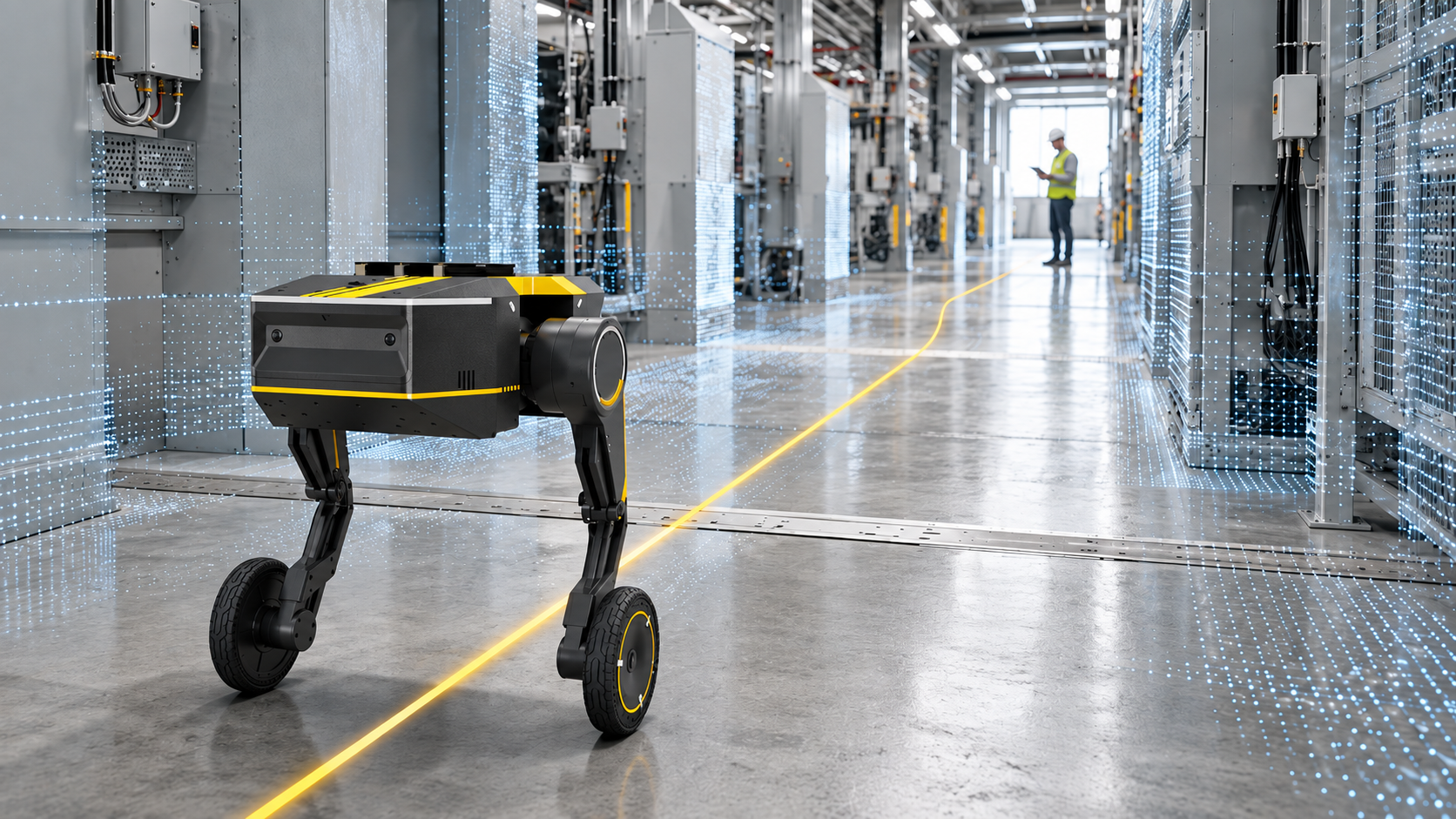
Our approach on TITA leans on a binocular structure scheme that gathers real-time 3D data of nearby objects with millimeter-level accuracy and strong stability. It also holds up well against environmental light interference and works without special lighting, which matters a great deal in warehouses, plant rooms and half-lit corridors where lighting is rarely designed with robots in mind.
What Depth Sensing Adds to TITA’s 3D Perception
Depth sensing gives TITA more than a flat visual image of its surroundings. Instead of relying only on camera input, the system can measure distance information from nearby objects and use that data to build a more practical understanding of the space around the robot.
For a moving robot, this matters because obstacle avoidance depends on fast and reliable distance awareness. When TITA approaches furniture, walls, people or uneven spaces, depth data helps the robot judge what is in front of it, how far away it is and whether the path ahead is still usable. Combined with cameras, inertial sensors and ultrasonic sensing, this depth information supports more stable autonomous positioning and smarter obstacle avoidance in real-world environments.
Multi-sensor fusion is what makes TITA dependable
No single sensor deserves to be trusted alone, and we designed around that reality. Our published TITA specification covers two SPAD sensors, two built-in cameras, two inertial sensors and one ultrasonic sensor, all feeding an NVIDIA Jetson Orin NX 16G computer rated at 100 TOPs of AI performance. The SPAD units contribute quick, reliable distance readings. The cameras supply structure and context. The inertial sensors track how the body itself is moving. The ultrasonic sensor adds a short-range distance channel that can help the system cross-check nearby obstacles when visual or light-based readings are less reliable.
Fused together, these inputs drive the autonomous decision-making system that handles perception, obstacle avoidance and positioning. The practical payoff is a robot that keeps working when one channel has a bad moment, and honestly, that resilience is the difference between a demo and a deployment.
Perception only counts if the body can respond
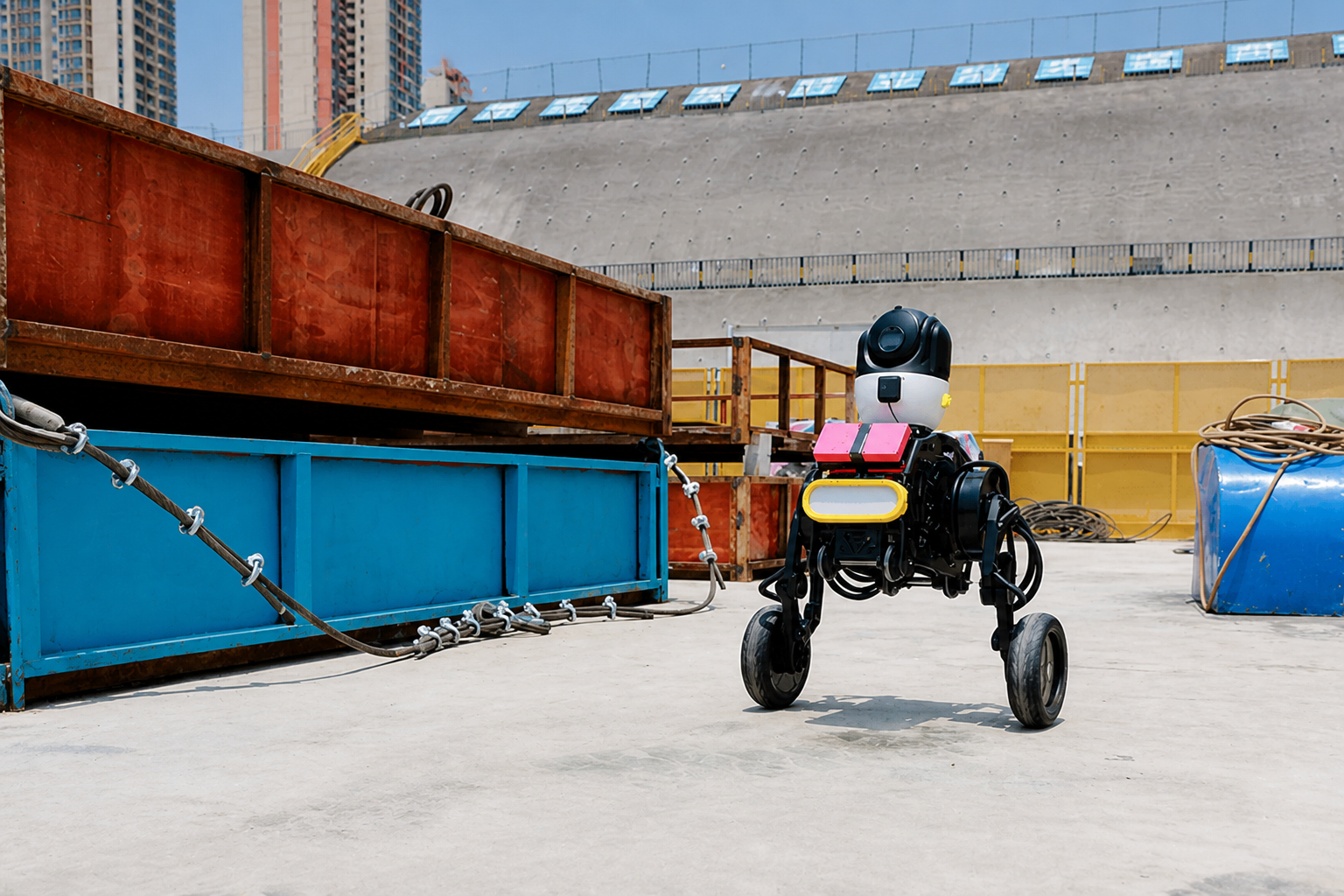
Spotting a hazard just ahead means nothing unless the chassis can act on it. TITA is an 8-DoF wheeled bipedal platform, so it rolls with the efficiency of wheels and adapts with the flexibility of legs. It carries a 10 kg moving payload, handles slopes of ±30°, manages a 20 cm forward jump and a 30 cm vertical jump, and runs at a standard maximum of 3 m/s with API unlock available up to 5 m/s where the environment and safety controls suit it. Those figures describe our own platform under our own test conditions, and they are not an industry-wide benchmark for wheeled robots in general, so every team is welcome to validate them against the intended site.
The quasi-direct drive joints deserve credit here too. Stripping out gearboxes gives the control loop a wider bandwidth and a higher update rate, so posture corrections happen crisply. Quiet operation and strong endurance come along for the ride, with hot-swappable batteries supporting roughly two hours of work and about one hour per battery.
Where teams put this to work
Inspection and mapping across parks, mines and industrial sites remain the most common use, closely followed by security patrol and routine data collection. Short-distance delivery and reception duties suit the platform well, since the body stays level while the wheels do the travelling. Filming crews use it as a mobile camera base. Universities and teaching labs take it on for research and secondary development, and that group tends to push the perception stack hardest. Teams weighing TITA against our other platforms can compare the full Direct Drive Tech robot lineup before committing.
Open enough to build on
A perception platform that cannot be extended has a short life, so TITA ships with ROS 2 support, full-link API access, a motor interface and an open Linux kernel source. TITA Bridge acts as a universal attachment system for mounting external accessories quickly, whether that means a TITA Tower for 3D mapping, a robotic arm base or a custom sensor of someone else's design. Setup videos, the user manual and the Ubuntu development documentation all sit together on our TITA tutorials page for teams getting started.
Our conviction at Direct Drive Tech has stayed consistent since the company began, which is that robots earn their place by working alongside people in messy, unscripted spaces. Better distance sensing, sensible fusion and a chassis quick enough to obey what the sensors report are how that ambition turns into something a customer can actually switch on.