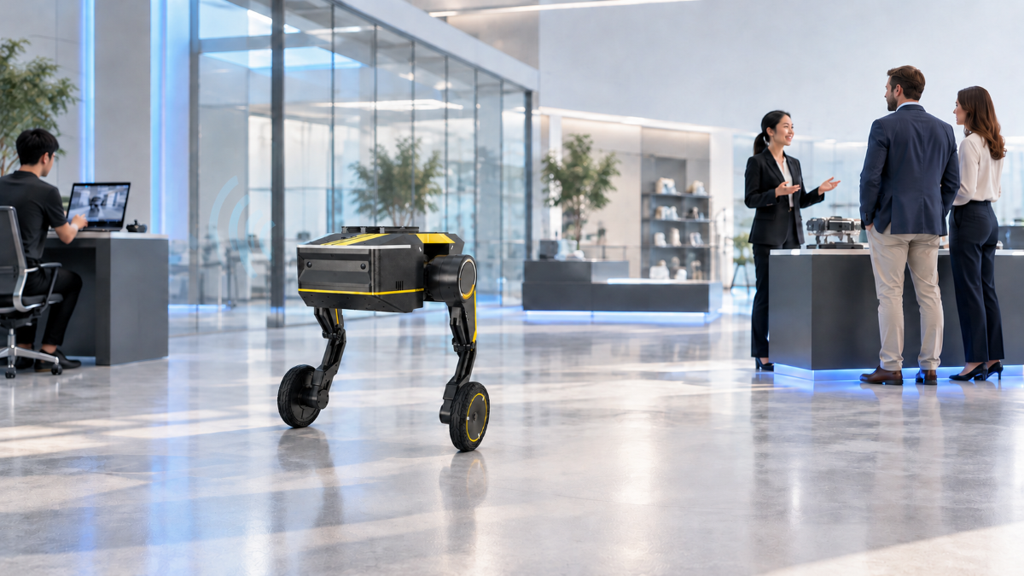
At a campus or industrial site, a security team may receive an alert without knowing whether it requires immediate intervention. A fixed camera can provide context from one angle, but it cannot follow a changing situation. Sending a staff member to check every alert may also be inefficient. A mobile platform adds a practical middle layer: it can move to an authorized area, transmit live imagery, and let an operator decide what to do next.
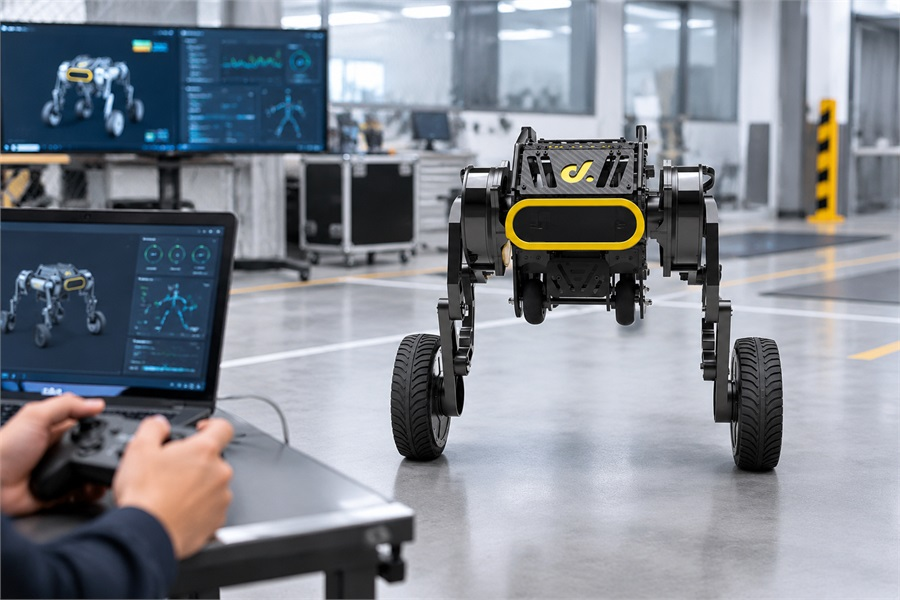
Our TITA Security Robot Platform can provide a mobile development foundation for this workflow. Integrating security alerts, alarm sources, operator permissions, and response procedures requires project-specific design and testing. Its 8-DoF wheeled bipedal structure supports mobile inspection, while remote image transmission, remote speaker support, automatic safe stop, hot-swappable batteries, and ROS 2/API access support supervised operation and further development. The TITA Tower accessory is required for 3D mapping. TITA works best as part of a broader security setup, complementing fixed cameras and on-site personnel when a location needs mobile visibility. Remote image transmission can extend the team’s view, but it does not by itself provide unlimited-distance control or unattended patrol. When autonomous navigation is not in use, TITA must remain within the operator’s line of sight. Autonomous inspection routes and alarm-to-response workflows require separate integration and validation.
Where TITA Fits in a Security Deployment

TITA can be useful when a security team needs visibility across multiple locations without sending staff to check every alert in person. A fixed camera can monitor an entrance continuously, but it cannot move when an issue occurs somewhere else. TITA provides a mobile viewpoint for authorized inspections and visual data collection. TITA includes remote speaker support, but whether it can be used for announcements depends on the selected speaker-control interface and software version.
On a campus, the platform can support monitoring along open paths, parking areas, building approaches, and other approved zones during low-traffic periods. An operator can check whether a route is clear, investigate a visual alert, or, where the selected configuration permits it, communicate with someone near the robot. At an industrial site, TITA is better suited to open-area inspections, perimeter observation, data collection, and route-based monitoring. Its 8-DoF wheel-legged structure also gives research and integration teams a flexible foundation for developing site-specific applications. For a related discussion of TITA in industrial inspection and research, see our TITA industrial inspection and research guide.
These applications also have practical limits. TITA is best suited to controlled, open areas with suitable lighting and stable communication. For permanent fixed coverage or deployments exposed to severe weather and heavy public traffic, fixed cameras may be a better fit.
How TITA’s capabilities match remote monitoring needs
Mobility for Controlled, Uneven Routes
Our TITA combines an 8-DoF wheel-legged design with a maximum slope of approximately ±30 degrees, a standard maximum speed of 3 m/s, a maximum forward jump of 20 cm, and a moving payload of up to 10 kg. These specifications apply to different operating conditions: jumping is limited to a 2 kg load, while a 10 kg moving payload requires avoiding medium- and high-speed modes. The full payload, maximum speed, and jumping capability should therefore not be understood as simultaneously achievable under the same conditions. Within these operating limits, TITA can support inspection and monitoring across controlled routes with changing terrain, while an on-site survey helps teams plan an efficient operating path.
With a platform weight of 24.1 kg without the battery, TITA should be evaluated as a complete system when planning transport, ramps, storage, and recovery. Additional equipment such as cameras, communication devices, or lighting can also affect balance and braking. Plan these elements around the complete configured system; when the moving payload reaches 10 kg, follow the restriction against medium- and high-speed modes.
Visual Awareness and Operator Communication
TITA combines two built-in cameras with inertial, SPAD, and ultrasonic sensors to help it perceive its surroundings, estimate position, and respond to obstacles. Its stereo cameras provide depth information for visual perception, while sensor fusion supports movement across the operating route. For projects that require terrain exploration, obstacle bypass, or 3D mapping, the TITA Tower accessory is required.
Remote monitoring becomes more useful when operators can respond, not just observe. With remote image transmission, the team can inspect a location and assess the situation. TITA includes a remote speaker that can support on-site communication when the selected software version and control interface provide the required functions. For example, an operator may guide a visitor toward an authorized entrance or ask people to keep clear of a restricted area. Audio customization is not currently supported in the image-transmission development version, so the available speaker functions should be established during project integration.
Battery Continuity and Integration

TITA uses hot-swappable batteries and supports approximately two hours of operation with a two-battery setup, or about one hour per battery. The hot-swappable design helps teams maintain operating continuity by preparing a charged spare battery, but it does not create unlimited runtime. Set patrol or inspection windows according to the actual battery setup and operating conditions.
Development teams can build on TITA’s NVIDIA Jetson Orin NX 16GB computing platform, 100 TOPS of AI performance, open Linux kernel source, full-link API access, motor interface, and ROS 2 support. The TITA tutorials and development resources provide setup and secondary development materials. Connecting TITA with a video management system, cloud dashboard, access-control platform, or alerting workflow requires project-specific design and testing. Integrators should also define data transmission, storage, access permissions, and the response procedure for communication interruptions.
A Practical Security Robot Solution
Consider a campus or industrial site where a fixed camera flags movement near an entrance, perimeter, or equipment area but cannot show what is happening beyond its fixed view. TITA can serve as a supervised mobile viewpoint: an operator can move it to an authorized position, receive image data, and assess whether the route or area requires attention. TITA’s native platform functions cover mobility, built-in cameras, remote image transmission, automatic safe stop, and ROS 2/API-based development. The alarm system still needs an integration layer to pass the alert, assign or trigger a mission, manage operator permissions, record the result, and route any escalation.
Identify the information gap. Define what the fixed camera cannot show and what visual evidence would help the team decide whether an alert requires inspection, maintenance, or escalation.
Use TITA’s native workflow. Select an authorized inspection position and determine whether the task uses supervised remote control or an autonomous navigation function. When autonomous navigation is not in use, keep TITA within the operator’s line of sight.
Build the alert handoff. Connect the alert source with the mission process, operator permissions, image transmission, event records, and escalation rules. These business links require project-specific software integration.
Screen the route conditions. Exclude routes with poor communication signals, strong electromagnetic interference, poor lighting, crowded areas, public-road exposure, severe weather, or terrain that the robot and sensors cannot reliably handle.
For a campus, the first test may cover a building approach, parking path, or perimeter section during a low-traffic, adequately lit period. For an industrial site, it may focus on one equipment area or defined inspection zone. Start with one route or zone and record communication stability, battery changes, route exceptions, operator workload, and the time needed to turn an observation into an assigned action. Use these findings to decide whether mobile image review adds enough value to justify expanding the deployment.
Deployment requirements to verify before ordering
Before ordering, verify the intended route, lighting, communication environment, control mode, payload, and software version against the table below; obtain our applicable specification for any configuration with a different operating boundary, and request a compatibility review for any custom or third-party attachment.
| Requirement | Deployment boundary |
|---|---|
| Environment | Use TITA in open, controlled areas. Do not use it in crowded places, on public roads, in severe weather, in water-prone locations, near flammable materials or heat sources, or on surfaces that its sensors may not reliably interpret. |
| Communication | Do not deploy TITA where communication signals are poor, many wireless devices are operating, or strong electromagnetic interference is present. Building walls, rocks, forests, Wi-Fi hotspots, routers, Bluetooth devices, high-voltage power lines, substations, mobile phone base stations, and television broadcast towers can interfere with control, sensors, or communication. A passing signal test or safe-stop procedure does not make an unsuitable environment appropriate for use. |
| Lighting | Use adequate and consistent lighting rather than dawn, dusk, night, or other poor-light conditions. Camera measurement functions require more than 200 lux, protection from direct sunlight that affects image quality, and normal-color image capture. This threshold does not by itself establish a suitable condition for night security. |
| Supported accessories | TITA offers optional accessories including TITA Tower, a high-capacity battery, 18-inch wheels, and a power adapter module (robot-arm base).. Evaluate the weight, center of gravity, power demand, mounting interface, and software support of the selected accessory. |
| Custom and third-party attachments | Do not assume that a non-factory attachment is compatible based only on its weight, center of gravity, or power requirements. Mechanical, electrical, control, and software compatibility should be reviewed by us before use. |
| People and compliance | Train operators in startup, shutdown, battery handling, emergency stopping, obstacle awareness, and abnormal behavior. Authorize the operating area and camera use, protect privacy, and meet local requirements for robots, recording, and monitoring. When autonomous navigation is not in use, keep TITA within the operator’s line of sight and away from people, vehicles, and objects that could be damaged in a collision. |
When TITA Is the Right Security Robot Platform
TITA is relevant for campus and industrial teams that need a mobile layer for authorized inspection and remote image verification, while also having the resources to validate project integration. It can complement existing security infrastructure when a movable viewpoint adds information that a fixed camera cannot provide.
A small, documented pilot is the best starting point. Share the intended site, route, payload, operating conditions, and integration goals when reviewing the TITA robot platform. For help selecting the configuration, accessories, and technical requirements, contact our team. This gives campus and industrial teams a clear basis for deciding how TITA could fit their security and inspection workflows.